Dental Bone Graft in Chișinău
A dental bone graft is an operation that restores jawbone volume where there is too little of it for an implant. After a tooth is removed, the bone gradually loses width and height, and bone augmentation for an implant gives it back the size it needs. Our implant surgeon Roman Casian performs the procedure, and the plan is built from a CBCT scan (3D dental scan).
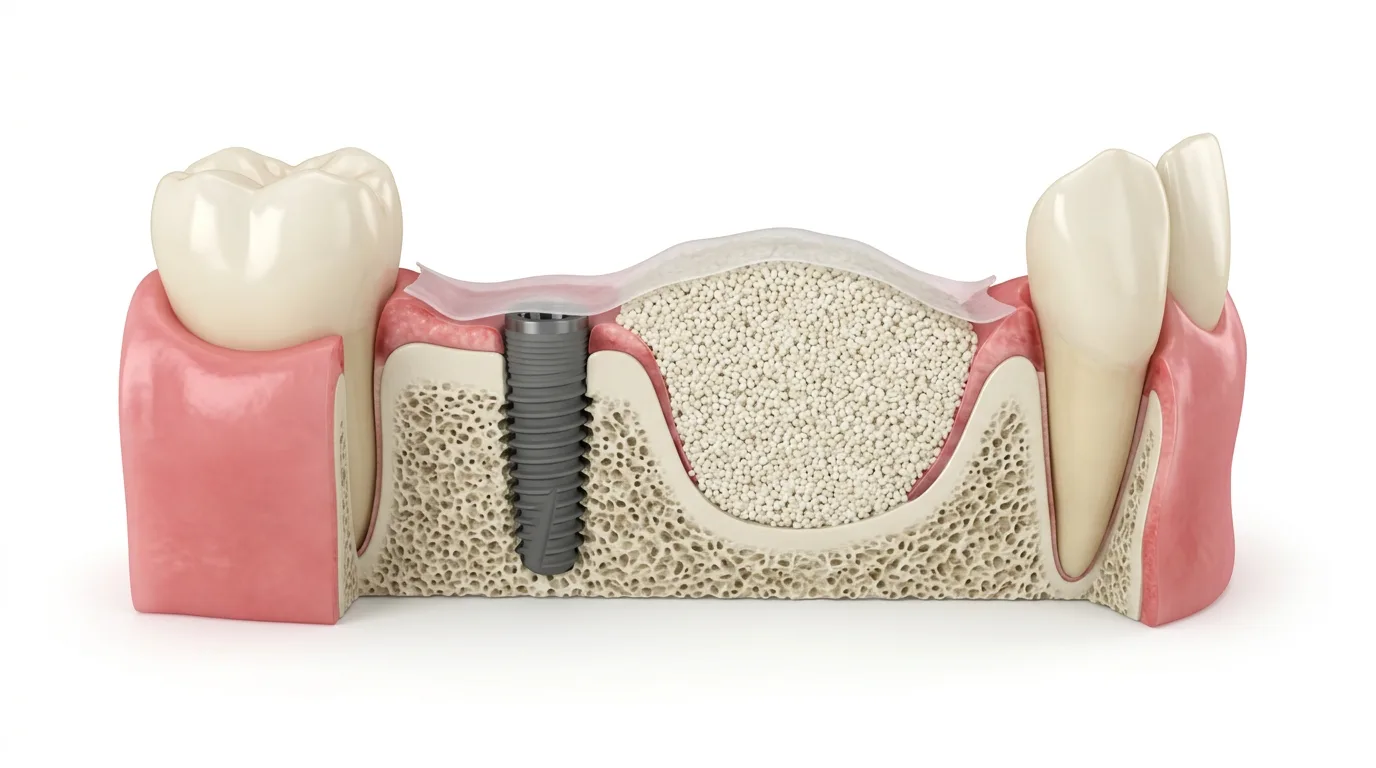
What is a dental bone graft
Jawbone stays healthy under load: a tooth root passes the pressure of chewing to it, and the bone keeps its shape. When the tooth is gone, the bone in that spot is no longer loaded and starts to shrink. This happens fastest in the first months after extraction and then continues for years. In our experience, the socket loses part of the width of the bony ridge (the part of the jaw that holds the teeth) after extraction, and preserving the bone right after the tooth is removed reduces that loss.
For an implant to integrate reliably, it needs a layer of your own bone on every side. If the ridge has become thin or low, the implant either has nothing to rest on or part of it ends up uncovered. A dental bone graft restores the missing volume. The surgeon places bone material or fixes thin plates of bone, covers them with a membrane and gives the tissues time to rebuild. Guided bone regeneration works because the membrane keeps soft tissue out of the surgical area, so new bone can form undisturbed underneath.
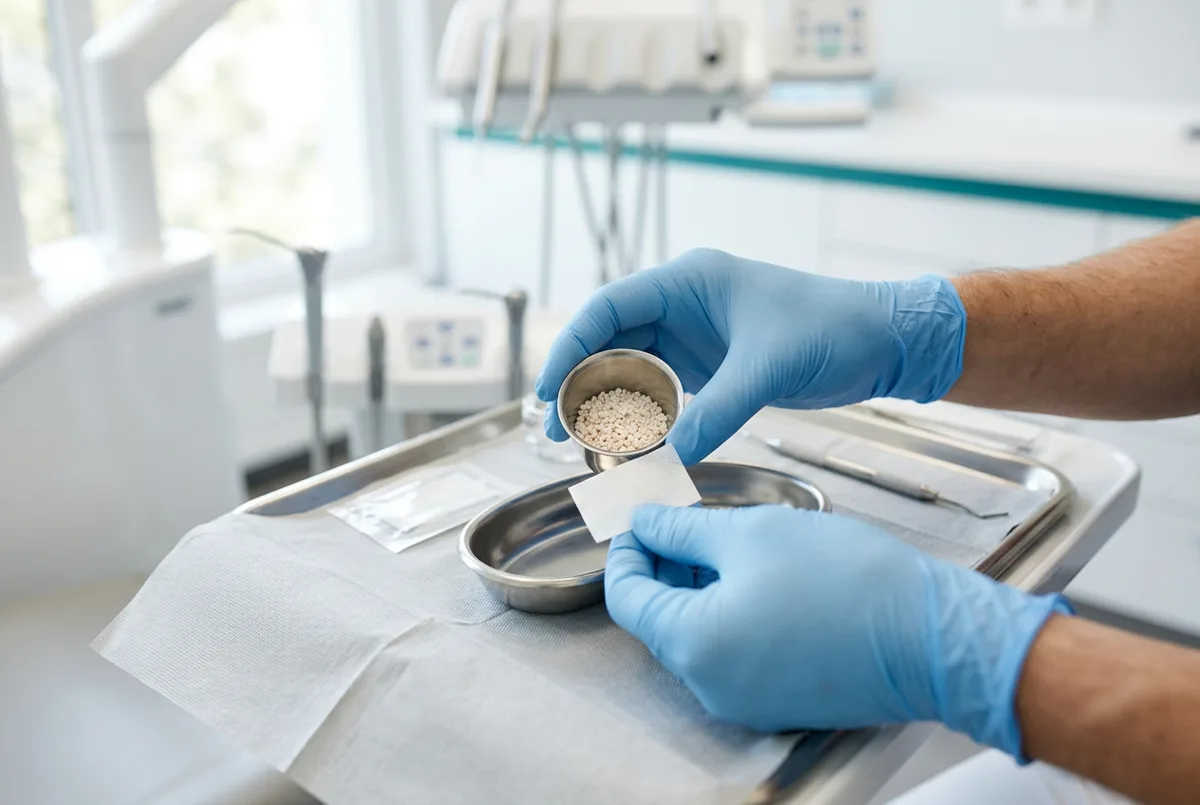
When bone augmentation for an implant is needed
Bone augmentation for an implant is needed if a tooth was removed long ago and the ridge has become noticeably thinner, if the extraction was difficult or came with inflammation, if bone broke down around a diseased tooth or an old implant, and after injuries. Sometimes a bone deficit shows up only on a 3D image: the gum looks normal, but the CBCT scan shows that the bone is too narrow. A follow-up CBCT scan is free for our patients.
Before the operation, cavities and gum inflammation have to be treated, professional teeth cleaning done, and your doctor told about chronic conditions and medication. Uncontrolled diabetes, smoking and poor hygiene slow bone healing, so the surgeon assesses these factors in advance and explains how to reduce the risks.
Types of dental bone graft
Technique | When it is used | Price at Cristi Dent |
|---|---|---|
Bone augmentation for 1 implant | a small defect around one tooth | 6,000 MDL |
Bone augmentation for 1 segment | a defect spanning several teeth | 8,000 MDL |
Bone block (Khoury technique) | marked loss of ridge width or height | 14,000 MDL |
For small defects, we do the dental bone graft with guided bone regeneration: bone material is placed in the defect and covered with a membrane. Often this is done on the same day as the implant. If a longer stretch of the jaw has to be rebuilt, we work on the whole segment at once, so that several implants can later be placed in the right position. Horizontal augmentation restores the width of the ridge.
The Khoury technique is used when a lot of bone has been lost. The surgeon takes thin plates of the patient's own bone, fixes them with micro-screws at the right distance from the ridge and fills the space between them with bone particles. This creates a framework inside which new bone forms. Vertical augmentation, when height has to be added, is technically harder than horizontal and calls for an experienced surgeon.
When another solution is possible
A bone graft is not always necessary. If there is enough bone, we place an ordinary dental implant. In the side areas of the upper jaw, a lack of height under the sinus is restored with a different operation, a sinus lift. When all teeth are missing, All-on-4 is sometimes chosen: the implants are placed at an angle in areas where the bone is sufficient. If implants are not possible or you decline them, we consider dentures without implants. The surgeon explains which route suits you after the CBCT scan.
Results of a dental bone graft
The ridge again has the width and height needed for an implant of the right size.
The implant can be placed where it will best withstand the load and look natural.
The restored bone supports the gum, and the crown does not look elongated.
An implant surrounded by your own bone is more stable and copes better with chewing load.
Dental bone graft cost
Restoring a small defect around one tooth.
Restoring bone across several teeth.
Reconstructing the ridge with bone plates after marked bone loss.
The price depends on the size of the defect and the technique chosen, so the surgeon gives the final amount after the CBCT scan. An implant is usually added to a bone graft. We work with the AlphaBio (4,000 MDL), Megagen AnyOne (6,000 MDL), Megagen AnyRidge and Blue Diamond (8,000 MDL each) systems. A CBCT scan costs 700 MDL. Before treatment starts, you receive a plan with all the stages and a total that is fixed in advance and does not change along the way.
How a dental bone graft is done
The surgeon reviews the CBCT scan, measures the width and height of the bone, chooses a technique and draws up the plan.
Cavities and gum inflammation are treated, professional teeth cleaning is done, and the medication you take is checked.
The operation is performed under local anaesthesia chosen for you individually.
The surgeon makes an incision and lifts the gum to expose the defect.
Bone material is placed or bone plates are fixed, and a membrane goes on top.
The gum is stitched tightly and aftercare is prescribed. A few months later the implant is placed or we move on to prosthetics.
How long the treatment takes
Bone augmentation for an implant takes from half an hour to an hour and a half or two hours, depending on the volume. In the first days swelling, bruising and moderate pain are possible, and they pass within a week. Stitches are removed after about 10-14 days. The bone material matures over several months: after a small graft the implant is often placed at the same time, and after a bone block it is placed once new bone has formed. After the implant integrates, we make implant-supported prosthetics. The surgeon gives exact timing after the CBCT scan.
What happens if the bone is not restored
Without enough bone volume, an implant has no reliable support.
Without a tooth the ridge keeps thinning, and over time it becomes harder and more expensive to rebuild.
They tilt towards the gap, and the bite is disturbed.
When many teeth are lost, the bone shrinks and the features of the lower third of the face change.
Who performs the operations
Our implant surgeon and periodontist Roman Casian does the dental bone grafts. He completed postgraduate training and earned a master's degree in periodontology at University College London (Eastman Dental Institute), is a member of the International Team for Implantology (ITI) and won the international MegaGen MegaMind competition for implant surgeons. He also took a course on the muco-gingival approach to placing implants. His practice covers bone augmentation for implants, Khoury bone blocks, sinus lifts and complex tooth extractions. If a tooth still has to be removed, he discusses straight away how to preserve the bone in the socket: gentle tooth extraction that protects the tissues makes future implant placement easier.
After the operation, do not chew on the treated side, press on the gum with your tongue or fingers, smoke or visit a sauna. Choose soft, cool food, and use rinses and medication only as your doctor prescribes. If the swelling grows after the third day, you develop a fever or a stitch comes apart, contact us straight away.
Dental bone graft questions
Don't put off your dental health


