Sinus Lift in Chișinău
A sinus lift is an operation in which the surgeon raises the floor of the maxillary sinus and fills the space with bone graft material. This gives the side of the upper jaw the bone height it needs, so an implant can replace lost chewing teeth. The procedure is performed by our implant surgeon Roman Casian, and the exact scope of surgery is set from a CBCT scan (3D dental scan).
What Is a Sinus Lift
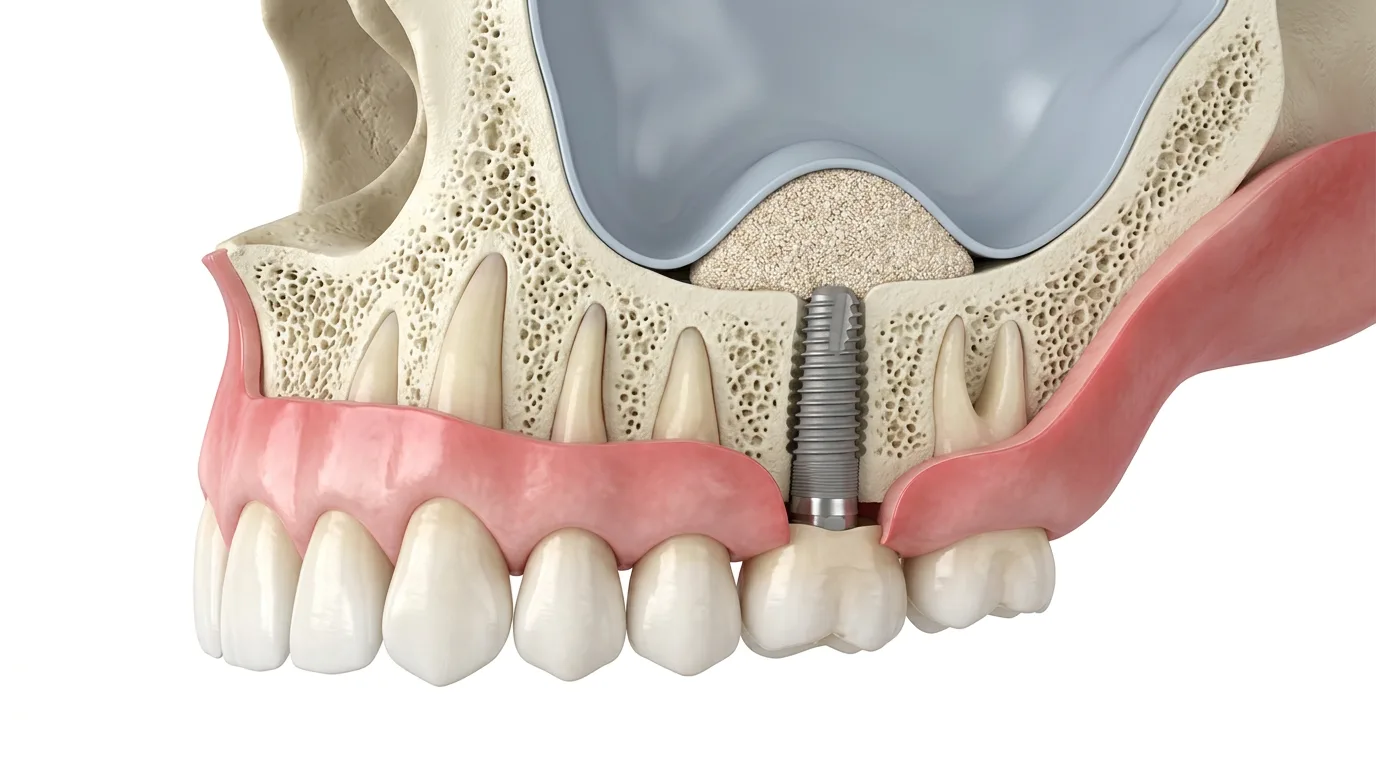
The maxillary sinus is an air-filled cavity above the roots of the upper premolars and molars. It is lined on the inside with a thin mucous membrane, known as the Schneiderian membrane. While the teeth are in place, chewing load keeps the bone under the sinus strong. After a tooth is removed, the bone in that spot gradually thins, and the sinus seems to drop down and take over the freed space. A few years after tooth loss there may be only a few millimetres of bone left between the sinus floor and the gum edge, which is not enough to anchor a standard-length implant securely.
A sinus lift solves this problem not in the sinus but beneath it. The surgeon carefully separates and lifts the membrane and places bone graft material into the new space. The membrane is lifted with care and usually stays intact. The sinus keeps working normally, and over a few months the graft is replaced by the patient's own bone. In our practice the key to success is keeping the membrane undamaged and creating a stable volume under it.
When You Need a Sinus Lift
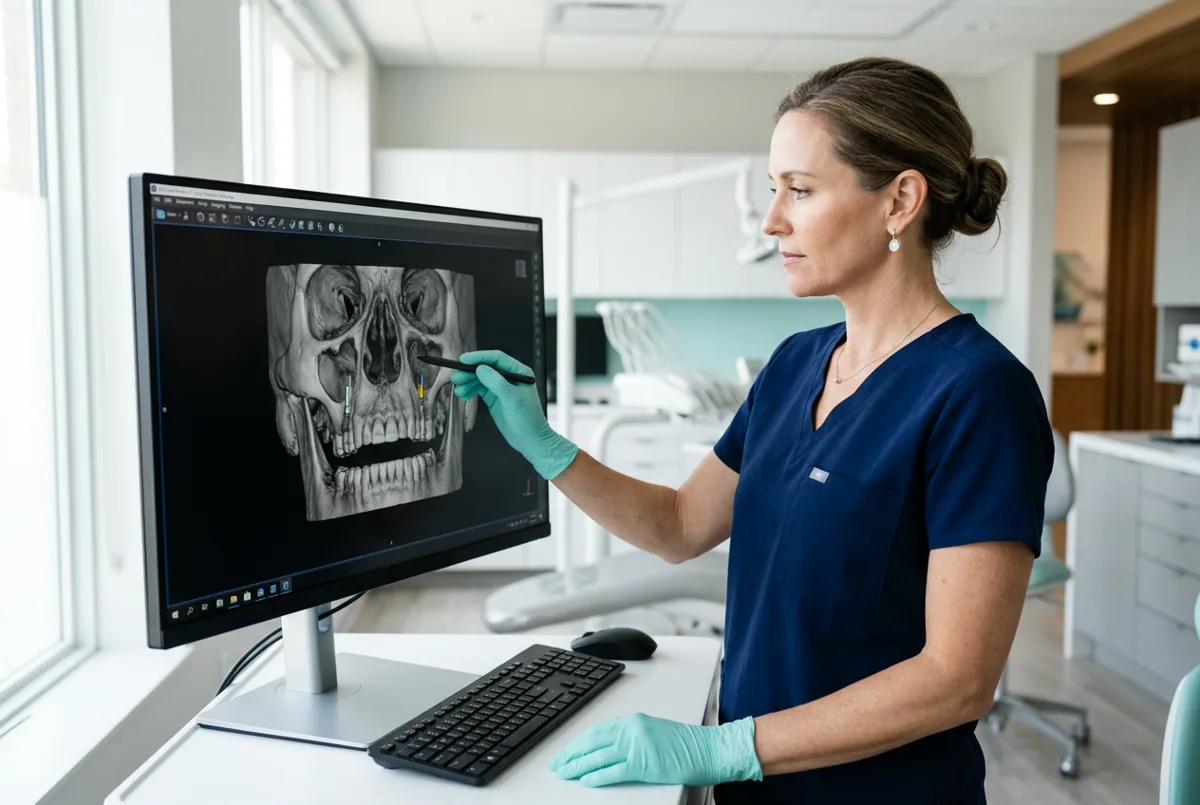
We recommend this operation when an implant is needed in the side of the upper jaw and there is not enough bone height under the sinus. Most often these are patients who lost their upper chewing teeth long ago. The cause may be chronic infection or a difficult extraction. Others have a large sinus whose floor naturally sits low. The decision is not made from an ordinary X-ray but from a 3D scan: a CBCT scan shows the height and width of the bone, the thickness of the membrane and the condition of the sinus itself.
A healthy sinus is essential. With acute sinusitis, a markedly thickened membrane, cysts or polyps, you first need treatment from an ear, nose and throat (ENT) doctor, and only then do we plan the operation. We also postpone the operation for uncontrolled general illnesses, during radiotherapy in this area and while there is active inflammation in the mouth. Smoking does not rule out the operation, but it slows bone healing, so we discuss it with you in advance.
Open vs Closed Sinus Lift: What Is the Difference
Parameter | Closed | Open |
|---|---|---|
Access | Through the hole prepared for the implant | Through a small window in the side wall of the jaw |
When it is suitable | A little bone is missing | Very little bone is left |
Implant placement | Usually the same day | The same day or after healing |
Amount of graft material | Small | Large |
Price | 4,000 MDL | 10,000 MDL |
The closed technique is done through the same hole that will later hold the implant. The surgeon gently raises the sinus floor with special instruments, adds a small amount of graft material and places the implant straight away. This method suits cases where there is still a noticeable layer of your own bone under the sinus, enough for the implant to be stable at first.
The open technique is needed when there is a marked bone deficit. The surgeon makes a small window in the side wall of the jaw, lifts the membrane to the required height through it and fills the space with graft material. The implant is placed at the same time if the bone can hold it, or a few months later, once the graft has matured. If bone has to be rebuilt on both sides, we perform a bilateral sinus lift: both sinuses in one operation.
When Another Solution Is Possible
Not everyone needs this operation. If the bone height is sufficient or a short implant can be used, standard dental implant placement goes ahead without extra surgery. When the bone loses width rather than height, we use ridge bone grafting (rebuilding the width of the jaw bone). When all upper teeth are missing, the All-on-4 concept is sometimes chosen: the back implants are tilted to bypass the sinus and rely on the bone that is there. The surgeon explains which option suits you after the CBCT scan.
Results of a Sinus Lift
There is room under the sinus for an implant of the right length to hold securely.
Lost upper teeth are replaced with implants and crowns, and chewing becomes fully functional.
The membrane is lifted with care and usually stays intact, so the sinus keeps working normally.
Implants placed after a sinus lift can work as reliably as those in ordinary bone when the bone has matured.
Sinus Lift Cost
Raising the sinus floor through the implant hole when a little bone is missing.
Raising the sinus floor through a side window when there is a marked bone deficit.
Restoring bone under both sinuses in one operation.
The cost of a sinus lift depends mainly on the technique: a closed procedure is simpler and shorter, while an open one needs side access and more graft material. The implant itself is added to the operation. We work with Alpha Bio (4,000 MDL), MegaGen AnyOne (6,000 MDL), as well as MegaGen AnyRidge and Blue Diamond (8,000 MDL each). A CBCT scan costs 700 MDL, and the follow-up scan is free for our patients. The surgeon prepares the full estimate after diagnostics and fixes it before treatment begins, so the amount does not change as the work goes on.
How a Sinus Lift Is Done
The surgeon studies the scan, assesses the bone height and the condition of the sinus, chooses the technique and draws up the plan.
Before the operation we treat caries and gum inflammation, carry out professional teeth cleaning and check which medicines you take.
The operation is done under local anaesthesia, chosen individually.
With a closed technique, through the implant hole. With an open technique, through a window in the side wall. The membrane is carefully separated and raised.
The space under the membrane is filled with bone graft material, and if stability is sufficient, the implant is placed straight away.
The wound is closed, and we give home care instructions and set follow-up visits. After a few months, you move on to the next stage.
How Long the Treatment Takes
A closed lift together with implant placement usually takes about an hour. The open technique takes longer, especially if implants are placed on the same day or the operation is done on both sides. In the first days you may have a swollen cheek, slight bruising and a blocked nose, and these pass on their own. The graft needs several months to mature. Only then do we move on to implant-supported prosthetics: we attach the abutment, the connector between the implant and the crown, and then the crown itself. The surgeon gives exact timing based on your CBCT scan, because it depends on the volume of restored bone.
What Happens If the Bone Is Not Restored
In thin bone an implant cannot get the stability it needs and may fail to integrate.
An implant placed without enough bone height can protrude into the sinus cavity.
Without load the bone keeps thinning, and over time it becomes harder to rebuild.
If the bone is not restored, mostly removable dentures remain for the side teeth.
Safety and Recovery
The most common complication of an open sinus lift is a tear in the sinus membrane. The surgeon closes a small tear with a special membrane during the operation, and with a large one the procedure is postponed. That is why precise planning from the CBCT scan and the surgeon's experience matter so much. These operations are performed by implant surgeon Roman Casian. He completed postgraduate training and earned a master's degree in periodontology at University College London (Eastman Dental Institute). He is a member of the International Team for Implantology (ITI) and won the international MegaGen MegaMind competition for implant surgeons.
After the operation it is important not to raise the pressure in the sinus. For several weeks, do not blow your nose hard, sneeze with your mouth closed, dive or fly without your doctor's permission. A cold compress on the cheek in the first hours, soft cool food and giving up smoking all help. We prescribe medicines individually, and they must be taken exactly as directed. If you have severe pain, a fever or foul-smelling discharge from the nose, contact us immediately.
Sinus Lift: Frequently Asked Questions
Don't put off your dental health


