updated
November 12, 2026
...
read
Types of Cavities and Why Tooth Decay Is Dangerous

Tooth decay is the destruction of the hard tissues of the tooth by acids that the bacteria of dental plaque produce. It is divided into types by depth and by location: initial, deep, between the teeth, on the biting surface and on the root. Without treatment, decay reaches the nerve, causes pulpitis (inflammation of the nerve) and can lead to the loss of the tooth. The type and the stage decide whether monitoring and fluoride are enough or the tooth already needs treatment.

What causes tooth decay
According to international studies cited by the WHO, decay of permanent teeth is one of the most common diseases in the world. The bacteria in plaque break down sugar and release acid. If acid attacks are frequent and the plaque is not removed, the enamel loses minerals faster than the saliva can return them. That is why, according to international studies, decay is regarded not as a one-off breakdown but as a process in which the tooth alternately loses minerals and regains them.
The process is slow, taking months and years, so a person has time to notice it. In dentine the destruction goes faster. Dentine, the inner layer of the tooth under the enamel, is softer than enamel. In our practice, the risk is most often raised by frequent sweet snacks and sugary drinks. According to international studies, a lack of fluoride, a dry mouth and poor hygiene add to this. At appointments we often see that the spaces between the teeth are left uncleaned.
Stages of tooth decay
The depth of the damage determines what we do with the tooth. Below are the stages of decay, from the earliest to the deepest.
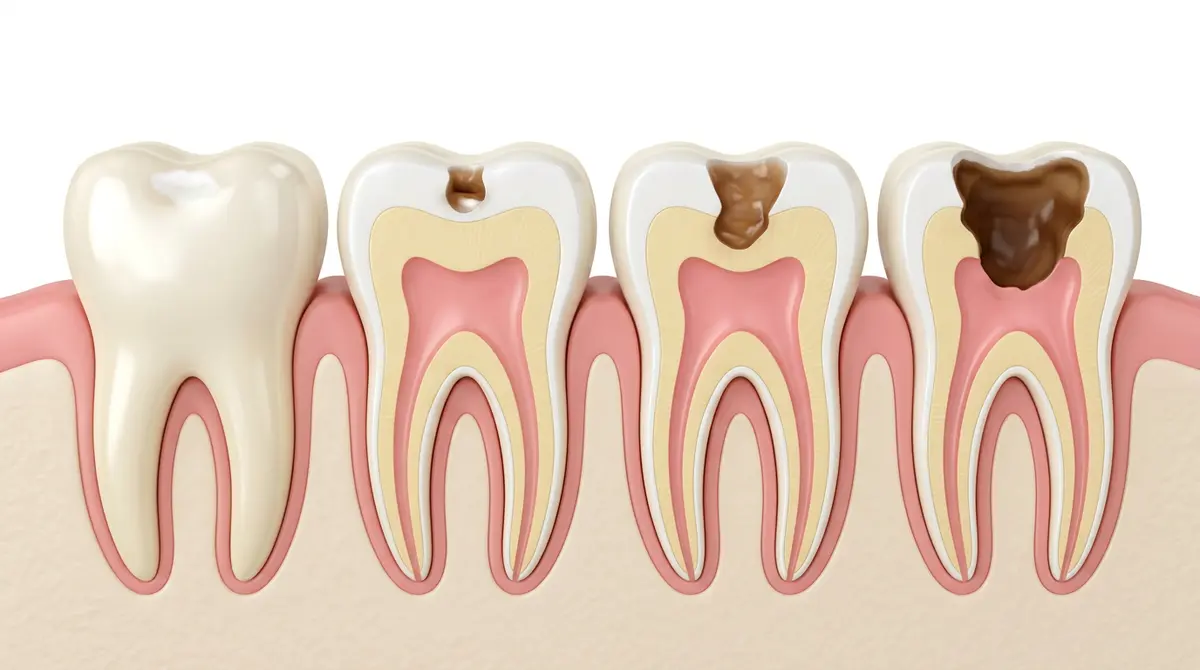
White spot stage
A white, chalky spot on the enamel, with no cavity. With good hygiene and fluoride the process can stop and even reverse.
Superficial decay
A defect within the enamel. Usually we place a small filling.
Moderate decay
The destruction reaches the dentine, and sensitivity to sweet and cold appears.
Deep decay
The cavity is close to the pulp, that is, to the nerve and the vessels inside the tooth, and the tooth reacts more strongly. Without treatment, decay turns into pulpitis, inflammation of the nerve, and then into inflammation at the root.
Types of cavities by location
| Type | Where it starts | Why it is treacherous |
|---|---|---|
| Decay on the biting surface | grooves and pits of the back teeth | plaque is trapped in the deep grooves |
| Decay between the teeth | the contact point of neighbouring teeth | the tooth looks intact from the outside, while there is already a cavity inside |
| Cervical decay (at the gum line) | at the gum edge | often combined with a receding gum and sensitivity |
| Root decay | an exposed root | the root has no enamel, so the destruction goes faster |
| Decay on the front teeth | between the teeth or at the neck | quickly spoils the look of the smile |
- Where it starts
- grooves and pits of the back teeth
- Why it is treacherous
- plaque is trapped in the deep grooves
- Where it starts
- the contact point of neighbouring teeth
- Why it is treacherous
- the tooth looks intact from the outside, while there is already a cavity inside
- Where it starts
- at the gum edge
- Why it is treacherous
- often combined with a receding gum and sensitivity
- Where it starts
- an exposed root
- Why it is treacherous
- the root has no enamel, so the destruction goes faster
- Where it starts
- between the teeth or at the neck
- Why it is treacherous
- quickly spoils the look of the smile
We treat damage at the neck of the tooth and on the root together with its cause, not just by filling it. On back teeth, we often find the areas of decay between teeth only on an X-ray.
At consultations we are often asked why to treat a tooth that does not hurt. In our practice, a small cavity in the enamel usually does not hurt at all, and the tooth starts to react to sweet and cold when the decay has already reached the dentine. The opposite also happens: a dark groove turns out not to be decay but plaque stained by coffee, tea or tobacco. So we do not judge by colour. We first check the surface and, if necessary, take an X-ray.
Have you noticed a spot or a dark dot on a tooth?
We will check your teeth, including the spaces between them, and tell you whether you need treatment.
Types of dental cavities by Black's classification
The American dentist Greene Black proposed this classification more than a century ago, and it is still used to describe cavities. There is also the international ICDAS system (International Caries Detection and Assessment System). According to international studies, it rates the tooth surface on a seven-point scale, from healthy to an extensive cavity, so it also describes the earliest changes.
How we determine the type of decay
First we examine the teeth in good light, with the surface dried, because early white spots are easier to see that way. We check the spaces between the teeth on close-up X-rays. These are images of one to three teeth. The eye often cannot assess the spaces between teeth. Based on the findings, we decide whether monitoring and fluoride are enough or a filling is needed.
Can decay form under a filling
Yes. This is called secondary decay. Plaque builds up at the border between the filling and the tooth, and bacteria penetrate inside. Such decay often develops unnoticed, so we advise not skipping check-ups and X-rays.
When to see a doctor urgently
- severe or night-time pain;
- swelling of the gum or cheek;
- a raised temperature together with toothache.
This article is for information and does not replace an examination by a dentist.
How to remove tooth decay
You cannot remove decay at home: only a doctor removes the affected tissue. At the white spot stage we manage without a filling. According to international studies, such areas can be stopped or reversed by remineralisation, that is, by returning minerals to the enamel with the help of fluoride. We also treat white spots with the Icon method, in which the enamel is infiltrated with a special resin. Both methods work only at the white spot stage, while there is no cavity.
For decay, we remove the softened tissue under anaesthesia and place a filling. If the nerve is affected, we carry out root canal treatment, under a microscope where needed. You can read more about difficult situations on the page about deep caries treatment.
Our article on the signs of cavities you should not ignore describes the early signs you should not put off a visit for.
How much caries treatment costs at Cristi Dent
Prices are valid as of 19 October 2026. We determine the scope of treatment after an examination. More on the caries treatment page.
Has it been a long time since your last check-up?
Book a free consultation: we will check your teeth and tell you whether there is early decay.
Where to go
If you have noticed a spot, a dark dot or sensitivity, book an examination. At Cristi Dent we provide caries treatment from small fillings to complex cases.
Sources
- Pitts NB et al. Dental caries. Nat Rev Dis Primers. 2017;3:17030 pubmed.ncbi.nlm.nih.gov/28540937
- Selwitz RH et al. Dental caries. Lancet. 2007;369(9555):51-59 pubmed.ncbi.nlm.nih.gov/17208642
- Ismail AI et al. The International Caries Detection and Assessment System (ICDAS). Community Dent Oral Epidemiol. 2007;35(3):170-178 pubmed.ncbi.nlm.nih.gov/17518963
- Urquhart O et al. Nonrestorative Treatments for Caries: Systematic Review and Network Meta-analysis. J Dent Res. 2019;98(1):14-26 pubmed.ncbi.nlm.nih.gov/30290130
- WHO. Oral health, fact sheet www.who.int/news-room/fact-sheets/detail/oral-health
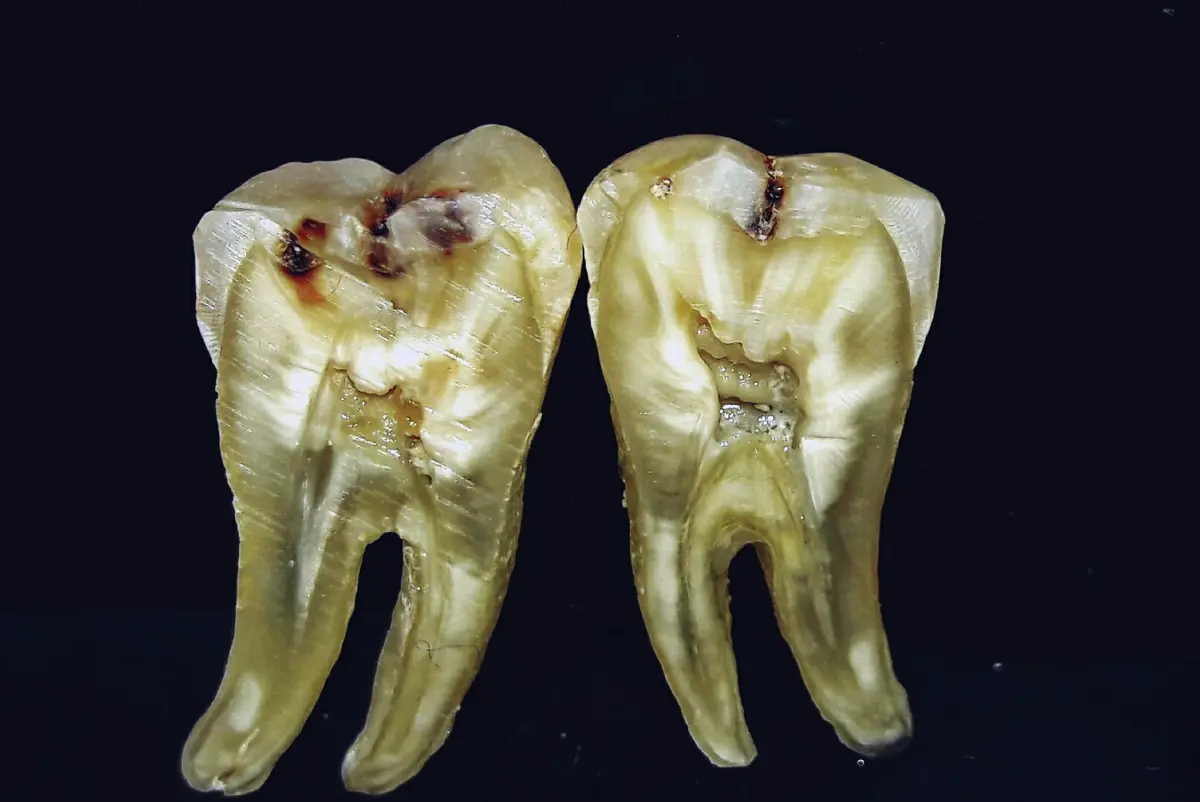
Images in the article: a cross-section of a tooth with decay: Mohamed A.M. Ahmed, CC BY 4.0, Wikimedia Commons.jpg).
Prevention
- brush twice a day with a fluoride toothpaste;
- use floss or interdental brushes for the spaces between the teeth;
- cut down on sweet snacks;
- see a dentist every six months, even if nothing bothers you.
Why untreated decay is dangerous
- pulpitis with severe, sometimes night-time pain;
- death of the nerve and inflammation at the tip of the root;
- abscess and swelling;
- destruction of the crown of the tooth and its loss.
Frequently asked questions
Deep decay, because it is close to the nerve. Areas of decay between the teeth and on the root are also treacherous: they develop unnoticed for a long time.
Once a cavity has appeared, decay usually does not stop on its own. It reaches the nerve, causes pulpitis, then inflammation at the root, and in the end the tooth can be lost.
Severe pain comes on by itself, often at night, lingers after cold or hot food and drinks, and spreads to the ear or temple. We determine this exactly with tests and an X-ray.
Yes. A white spot with no cavity can often be stopped with good hygiene and fluoride. We monitor it at check-ups and say whether additional protection is needed, for example a fluoride varnish.
A consultation with a specialist doctor at Cristi Dent is free. We will check your teeth, including the spaces between them, and tell you whether you need a filling.
ARTICLE AUTHOR
Treats caries, restores teeth with fillings and works to preserve the patient's own teeth.