updated
November 12, 2026
...
read
Tartar on Teeth: Where It Comes From and Why You Cannot Remove It at Home

Tartar is hardened plaque. It holds firmly to the enamel and is not dissolved by toothpastes or folk remedies, at least not without harming the teeth themselves, which are made of the same minerals as tartar. It can be removed safely only in the dental office. At home the task is different: to stop new tartar from building up too quickly.

What tartar is
Soft plaque forms on the teeth every day. If it is not removed, mineral salts from the saliva, mainly calcium phosphates, are deposited in it. The film turns to stone layer by layer, right at the gum edge.
Tartar vs plaque comes down to hardness: plaque is soft and forms every day, while tartar is plaque that has hardened. A toothbrush removes plaque, but not tartar.
There is a detail that patients usually do not know. According to international studies, dental tartar is always covered on top by a living layer of plaque. A rough surface holds bacteria better than smooth enamel, so tartar acts as a permanent reservoir of microbes at the gum edge.
What causes tartar on teeth
The main cause is plaque that stays on the teeth longer than it should. But the speed at which it hardens differs from person to person. Two people with the same toothbrush and toothpaste come to us for cleaning with a completely different picture in the mouth. According to international studies, the speed is influenced by:
- how thorough your hygiene is, and whether you clean between the teeth;
- the time since your last professional cleaning;
- diet and age;
- general illnesses and some medicines.
In our practice, the characteristics of the saliva also matter: in some people tartar returns quickly even with good cleaning at home.

In people who brush regularly, tartar builds up where the ducts of the salivary glands open. These are the inner side of the lower front teeth and the cheek side of the upper chewing teeth. That is why many people first notice a yellowish strip behind the lower incisors.
Tartar below the gum line
There are two kinds of tartar, and they are dangerous in different ways.
Above the gum
visible in a mirror
- a yellowish or beige strip at the gum edge
- more often behind the lower incisors and on the upper chewing teeth
- irritates the gum, which is why it bleeds
Below the gum
you cannot see it yourself
- lies in a pocket, that is, in the gap between the gum and the root
- dark, almost black, and firmly attached to the root
- appears where there is already inflammation, and may not hurt at all
According to international studies, in people without regular hygiene, tartar below the gum is directly linked to the loss of the tissues that hold the tooth in place. You will not see it even with a good mirror and bright light. We find it at the examination and on X-rays.
Why tartar on teeth is harmful
It is not so much the tartar itself that is dangerous as what it sustains:
- constant irritation of the gum: it turns red, swells and bleeds;
- inflammation turning into periodontitis, that is, destruction of the tissues that hold the tooth;
- gum recession and exposed roots;
- persistent bad breath;
- a rough surface over which the toothbrush slides without cleaning.
We sometimes hear that tartar supposedly protects the tooth from caries. There is no point in leaving it for that reason: it remains a convenient place for bacteria and sustains gum inflammation.
Can you see a yellowish strip at the gum edge?
We will remove the tartar and check for deposits below the gum.
How to remove tartar from teeth at home
There is no way to do it without harming the teeth. Hard tartar is bonded to the enamel too firmly. Anything that could dissolve or chip it off at home damages the tooth itself and the gum. The logic of folk recipes for tartar removal at home is clear: acid dissolves minerals. But enamel is a mineral too.
Home remedies: what softens tartar and why you should not try them
| Remedy | What is promised | What actually happens |
|---|---|---|
| Vinegar, lemon juice | to dissolve tartar with acid | the acid washes minerals out of the enamel next to the tartar, opening the way to caries and sensitivity |
| Baking soda | to scrub off the deposits | works as an abrasive: it scratches the enamel, while the dense tartar stays |
| Hydrogen peroxide | to soften and whiten | irritates the gum and the mucosa, and does not dissolve hard tartar |
| A metal tool, a toothpick | to scrape it off yourself | scratch the tooth, injure the gum and push some of the deposits deeper under it |
- What is promised
- to dissolve tartar with acid
- What actually happens
- the acid washes minerals out of the enamel next to the tartar, opening the way to caries and sensitivity
- What is promised
- to scrub off the deposits
- What actually happens
- works as an abrasive: it scratches the enamel, while the dense tartar stays
- What is promised
- to soften and whiten
- What actually happens
- irritates the gum and the mucosa, and does not dissolve hard tartar
- What is promised
- to scrape it off yourself
- What actually happens
- scratch the tooth, injure the gum and push some of the deposits deeper under it
The acid that is able to act on tartar acts on enamel in the same way. We explained in more detail why baking soda and lemon harm the enamel in our article on teeth whitening and what damages the enamel.
During cleanings we are often asked whether baking soda or a hard toothbrush will do if the strip behind the lower incisors has only just appeared. In our practice, no. A toothbrush will remove soft plaque, but tartar that has already hardened stays, while the enamel and gum suffer. That is why we advise not rubbing that spot harder but coming in for hygiene.
What really helps at home
- brush your teeth twice a day with a fluoride toothpaste, not forgetting the inner side of the lower incisors;
- clean between the teeth every day with floss or interdental brushes;
- spit out the toothpaste after brushing, without rinsing your mouth with water;
- replace your toothbrush when the bristles start to splay.
How tartar is removed at the clinic
How to get tartar off teeth once it has hardened? Only in the dental office. Professional hygiene usually takes one visit.
Examination
We look at the gums and, if necessary, order X-rays.
Ultrasound
With a handpiece we break the tartar off by vibration, including at the gum edge.
AirFlow
A jet of powder under pressure removes soft plaque and stains from coffee and tobacco.
Polishing
We smooth the surface, because smooth enamel attracts less new plaque.
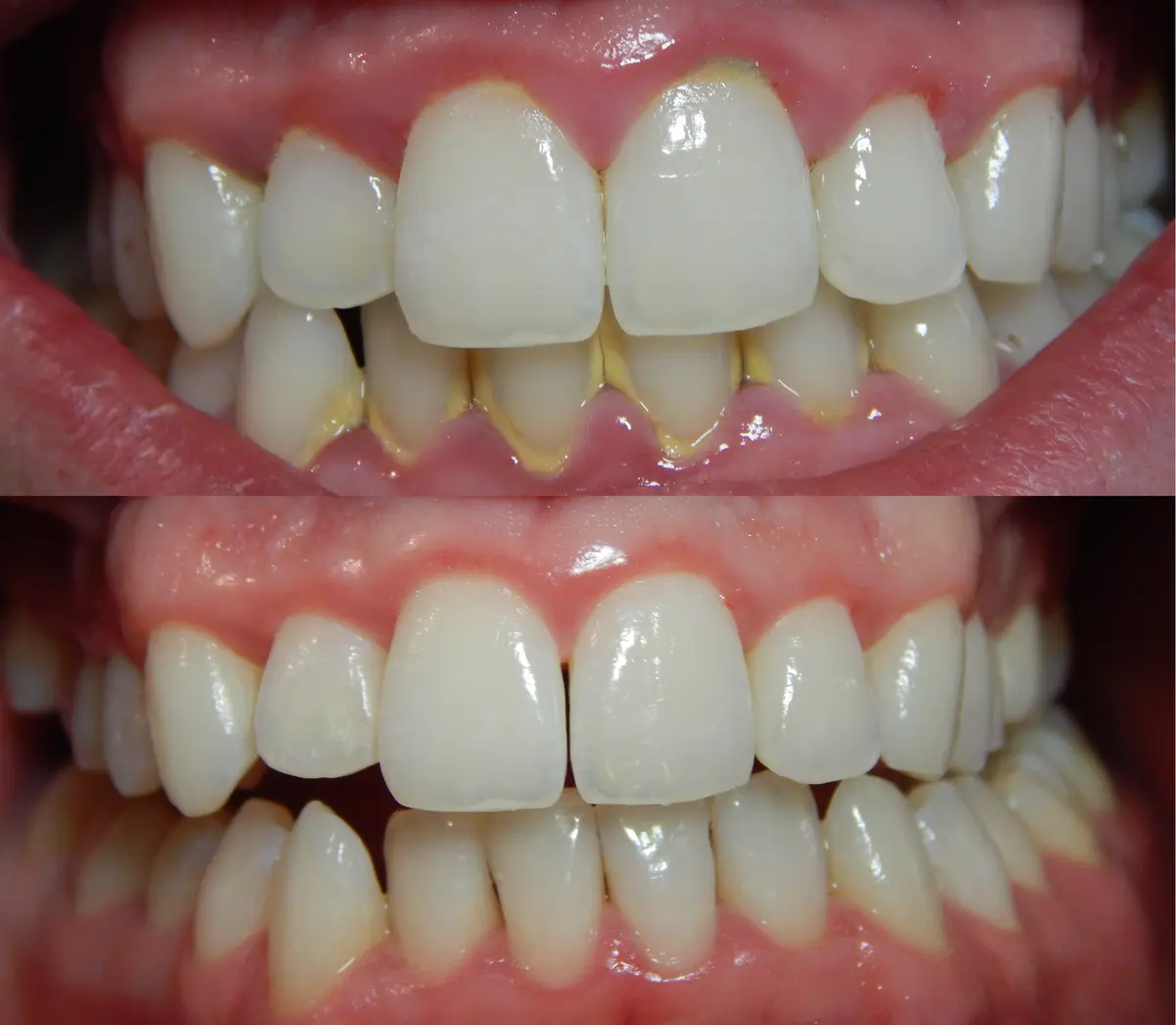
If the tartar lies deep below the gum and there are pockets, a deeper cleaning is needed. Sometimes we carry it out over several visits and under local anaesthesia, because we have to work on the surface of the root. Temporary sensitivity is possible afterwards. Separate AirFlow teeth cleaning removes plaque and stains well, but we remove hard tartar with ultrasound.
How much cleaning costs at Cristi Dent
Prices are valid as of 19 October 2026. More about the cost and content of the procedures on the professional hygiene page.
When to book without delay
- the gums bleed at every brushing or on their own;
- the gum is swollen, sore, or pus comes out from under it;
- a tooth has become loose;
- bad breath does not go away after cleaning;
- facial swelling with a raised temperature: this calls for urgent help.
This article is for information and does not replace an examination by a dentist.
How often you need a cleaning
In one person the strip behind the incisors comes back after a few months, in another the teeth are still clean after a year. There is no single interval.
We set the interval according to how fast tartar forms and the condition of the gums. We take into account braces and implants, if you have them, and how thoroughly you manage to brush at home.
Has it been a long time since your last cleaning?
Book professional hygiene: we will suggest the right interval for you.
Where to have tartar removed
If you see deposits or your gums have started to bleed, start with professional hygiene. We carry it out as part of our professional teeth cleaning with ultrasound and AirFlow at Cristi Dent in Chișinău. At the appointment we will remove the tartar, assess the condition of your gums and advise how often to come for cleaning.
Sources
- White DJ. Dental calculus: recent insights into occurrence, formation, prevention, removal and oral health effects. Eur J Oral Sci. 1997;105(5 Pt 2):508-522 pubmed.ncbi.nlm.nih.gov/9395117
- Akcalı A, Lang NP. Dental calculus: the calcified biofilm and its role in disease development. Periodontol 2000. 2018;76(1):109-115 pubmed.ncbi.nlm.nih.gov/29194797
- StatPearls. Dental Caries www.ncbi.nlm.nih.gov/books/NBK551699
- StatPearls. Periodontal Disease www.ncbi.nlm.nih.gov/books/NBK554590
- NHS. Gum disease www.nhs.uk/conditions/gum-disease
Images in the article: tartar behind the lower incisors: DRosenbach, Public domain, Wikimedia Commons; gums before and after cleaning: Onetimeuseaccount, CC0, Wikimedia Commons.
How to slow down tartar buildup
- brush your teeth twice a day, paying attention to the inner side of the lower incisors;
- clean between the teeth every day with floss or interdental brushes;
- come for professional hygiene on the schedule we set for you.
What not to do
- scrape off tartar with metal or a toothpick;
- rinse your mouth with vinegar or lemon juice;
- brush with baking soda every day;
- put off cleaning if your gums bleed.
Frequently asked questions
Tartar keeps bacterial plaque at the gum edge. First bleeding and bad breath appear, then the inflammation can go deeper and start to destroy the bone that holds the tooth. Deposits below the gum, which cannot be seen in a mirror, are especially dangerous.
For a few days the teeth may react to cold and the gums may bleed slightly. This usually passes quickly as the inflammation settles. Sometimes gaps between the teeth that tartar used to fill become noticeable.
No. A toothbrush and toothpaste remove soft plaque, but we remove hardened tartar only with instruments in the dental office. Attempts to scrape it off with sharp objects injure the enamel and the gum.
Most often, no. Above the gum, cleaning is done without anaesthesia, and slight sensitivity is possible. If the tartar lies deep below the gum, we work under local anaesthesia.
Book professional hygiene at Cristi Dent. We will remove the deposits, check your gums and advise how often to come for cleaning.
ARTICLE AUTHOR
Carries out professional oral hygiene, teaches tooth care and provides gum disease prevention, to maintain oral health and the results of treatment.