updated
November 12, 2026
...
read
Odontogenic Sinusitis: When a Tooth Is to Blame
The roots of the upper chewing teeth lie very close to the floor of the maxillary sinus, the air cavity in the upper jaw. Sometimes they are separated only by a thin plate of bone. That is why infection from a diseased tooth can pass into the sinus. This kind of sinusitis is treated for a long time as an ordinary cold. It keeps coming back until the cause in the mouth is found and removed. The main signs of odontogenic sinusitis are inflammation on one side, onset after the treatment or removal of an upper tooth, and an unpleasant smell from the nose.

Sinus infection or tooth infection: what odontogenic sinusitis is

Can a sinus infection cause tooth pain? In odontogenic sinusitis the chain runs the other way. Odontogenic sinusitis is inflammation of the maxillary sinus whose source lies in a tooth or in the jaw. So it is a sinus infection from a tooth. It is caused not by a cold virus but by bacteria from the mouth.
So if you have sinusitis, we advise you to have the upper teeth checked too, especially when the inflammation is on one side.
Causes of a tooth sinus infection
The source of infection on the mouth side can be different:
- inflammation at the tip of the root of an upper tooth after the nerve has died;
- deep periodontal pockets (gaps between the gum and the root when the gums are inflamed) around the upper chewing teeth;
- a communication, that is, an opening between the mouth and the sinus, after a tooth has been removed;
- filling material or a root fragment getting into the sinus;
- complications after implant placement and a sinus lift (building up bone under the floor of the sinus);
- a cyst growing from the root towards the sinus.
According to international studies, about two thirds of cases are linked to dental procedures: tooth extraction, root canal treatment and implant placement. According to a systematic review of 19 studies, the most common single cause is a communication between the mouth and the sinus.
At consultations we are often asked why sinusitis came back after a course of antibiotics. In our practice, the cause is often a tooth that does not hurt and looks healthy. For example, a tooth treated long ago with inflammation at the tip of its root. It can be seen only on an X-ray.
Sinus infection after tooth extraction
After an upper chewing tooth is removed, an opening is sometimes left between the socket and the sinus. The signs are that liquid gets into the nose when you rinse your mouth, air passes from the mouth into the nose, and there is a taste of pus. Such openings are closed surgically, and the sooner the better.
A cyst from a tooth in the maxillary sinus
A cyst from a tooth usually grows from the tip of the root of the affected tooth and pushes up the floor of the sinus. It is important to tell it apart from retention cysts, which are small fluid-filled bubbles in the lining of the sinus. They are often found by chance and are not connected with the teeth. A CBCT scan helps to sort it out: on it we can see where the formation starts and what condition the root is in.
Odontogenic sinusitis symptoms and how they differ from the usual kind
The signs are similar to ordinary sinusitis, but there are some particular features. In odontogenic sinusitis a toothache is not always present, and the tooth may look healthy.
Sinus infection vs tooth infection: ordinary or dental sinusitis
| Sign | Ordinary sinusitis | Odontogenic sinusitis |
|---|---|---|
| Side | more often both | more often one |
| Onset | after a cold | after the treatment or removal of a tooth, or alongside a diseased tooth |
| Smell | usually none | an unpleasant smell from the nose, a putrid taste |
| Toothache | none | not always present, the tooth can look healthy |
| Treatment by an ENT (ear, nose and throat) doctor | usually helps | helps only temporarily until the tooth is treated |
- Ordinary sinusitis
- more often both
- Odontogenic sinusitis
- more often one
- Ordinary sinusitis
- after a cold
- Odontogenic sinusitis
- after the treatment or removal of a tooth, or alongside a diseased tooth
- Ordinary sinusitis
- usually none
- Odontogenic sinusitis
- an unpleasant smell from the nose, a putrid taste
- Ordinary sinusitis
- none
- Odontogenic sinusitis
- not always present, the tooth can look healthy
- Ordinary sinusitis
- usually helps
- Odontogenic sinusitis
- helps only temporarily until the tooth is treated
See a doctor urgently if
- there is swelling of the eyelids or around the eye;
- your vision has worsened or you see double;
- you have a severe headache, a high temperature and tension in the neck muscles.
Complications are rare but dangerous: the inflammation can spread to the eye socket and into the cranial cavity. This article is for general reference only and does not replace a doctor's consultation.
Does sinusitis keep coming back on one side?
We will check the upper teeth on a CBCT scan and tell you whether a tooth is to blame.
How to treat odontogenic sinusitis
When the cause of sinusitis is dental, the source of infection in the mouth must be removed. That is our approach in practice. We assess the teeth and choose the method of treatment, and we advise you to see an ENT doctor to check the sinus. The ENT doctor decides whether the sinus needs separate treatment.
What we do
- we study the teeth on a CBCT scan
- we carry out root canal treatment or remove a tooth that cannot be saved
- we remove the source of infection on the mouth side
What the ENT doctor does
- examines the nose with an endoscope, a thin tube with a camera
- prescribes treatment for the sinus
- if necessary, operates on the sinus endoscopically through the nose
Odontogenic sinusitis: treatment without surgery
If the process began recently, removing the source is often enough: treating the root canals of the tooth or removing a tooth that cannot be saved. Antibiotics and sinus rinsing are prescribed by the doctor in charge. Without treating the tooth they give only a temporary effect.
Odontogenic sinusitis: when surgery is needed
Surgery is needed if there is a foreign body in the sinus, a large opening between the mouth and the sinus, a cyst, or if the inflammation does not go away after the tooth is treated. The ENT doctor usually works endoscopically through the nose. By that time the causative tooth must be removed or treated and the opening closed.
Sinus lift and implants
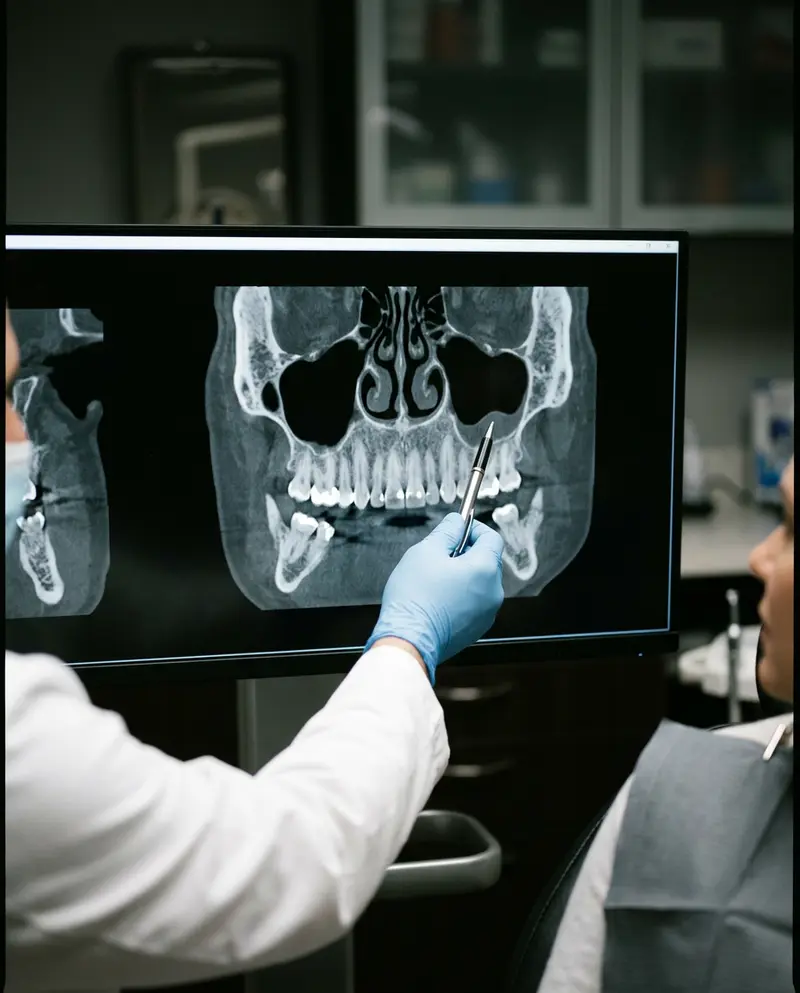
Before implant placement in the upper jaw, we always assess the sinus on the images. If there is not enough bone, we carry out a sinus lift, that is, we build up bone under the floor of the sinus. If the sinus is inflamed at the time, we postpone it until the inflammation has been treated.
Prices at Cristi Dent
Prices are valid as of 19 October 2026. We determine the scope of treatment from the CBCT scan. More on the page CBCT scan.
Need to check whether a tooth is to blame?
Book a consultation: we will order a CBCT scan and go through the image with you.
Where to go
If sinusitis keeps recurring on one side or began after dental treatment, show your teeth to a dental surgeon and have a CBCT scan. We carry out CBCT scans, root canal treatment and the removal of causative teeth at Cristi Dent in Chișinău. Removals are handled by our oral surgery department.
Sources
- Global Prevalence of Maxillary Sinusitis of Odontogenic Origin and Associated Factors: A Systematic Review and Meta-Analysis. J Endod. 2023;49(4):369-381 pubmed.ncbi.nlm.nih.gov/36754253
- Diagnosing odontogenic sinusitis: An international multidisciplinary consensus statement. Int Forum Allergy Rhinol. 2021;11(8):1235-1248 pubmed.ncbi.nlm.nih.gov/33583151
- Lechien JR et al. Chronic maxillary rhinosinusitis of dental origin: a systematic review of 674 patient cases. Int J Otolaryngol. 2014;2014:465173 pubmed.ncbi.nlm.nih.gov/24817890
- Etiologies and Treatments of Odontogenic Maxillary Sinusitis: A Systematic Review. Iran Red Crescent Med J. 2015;17(12):e25536 pubmed.ncbi.nlm.nih.gov/26756016
- Extrasinus Complications From Odontogenic Sinusitis: A Systematic Review. Otolaryngol Head Neck Surg. 2022;166(4):623-632 pubmed.ncbi.nlm.nih.gov/34253072
What to bring to your appointment
- images and conclusions from the ENT doctor, if you have them;
- a list of the medicines you have taken;
- information about which teeth have been treated or removed recently.
What not to do
- treat sinusitis with drops alone if it keeps coming back on one side;
- blow your nose hard after an upper tooth has been removed;
- take antibiotics without a prescription;
- put off having your teeth checked.
Frequently asked questions
Yes. The source of infection in the tooth has to be removed. We choose between root canal treatment and extraction, while the ENT doctor assesses the sinus and whether it needs separate treatment. Drops or antibiotics alone are not enough while the source of infection remains.
The timing is individual. While the cause in the tooth has not been removed, it does not clear. After the tooth and the sinus have been treated, we assess progress at follow-up visits.
Not always. If the tooth can be treated, for example through the root canals, we save it. We remove only a tooth that cannot be saved.
It is a sign of a communication between the socket and the sinus. It needs to be shown to a surgeon as early as possible: small openings are easier to close.
At a consultation at Cristi Dent we will examine the upper teeth and the sinus on a CBCT scan and tell you whether there is a dental cause.
ARTICLE AUTHOR
Carries out the surgical stages of treatment, including tooth extraction, preparation for implant placement and tissue restoration in complex clinical situations.