updated
November 12, 2026
...
read
Dental Implant Rejection and Peri Implantitis: Signs and What to Do
True dental implant rejection is very unusual. Titanium and zirconia are well tolerated by the body. The word usually means one of two things. Either the implant did not take and did not fuse with the bone in the first months. Or inflammation, known as peri implantitis, developed around it later and is destroying the bone. Inflammation responds to treatment better the earlier it is noticed, while a loose implant usually has to be removed. The main signs of a problem are a loose implant, bleeding gums and pus. If you notice any of them, we advise you to have the implant examined at once.
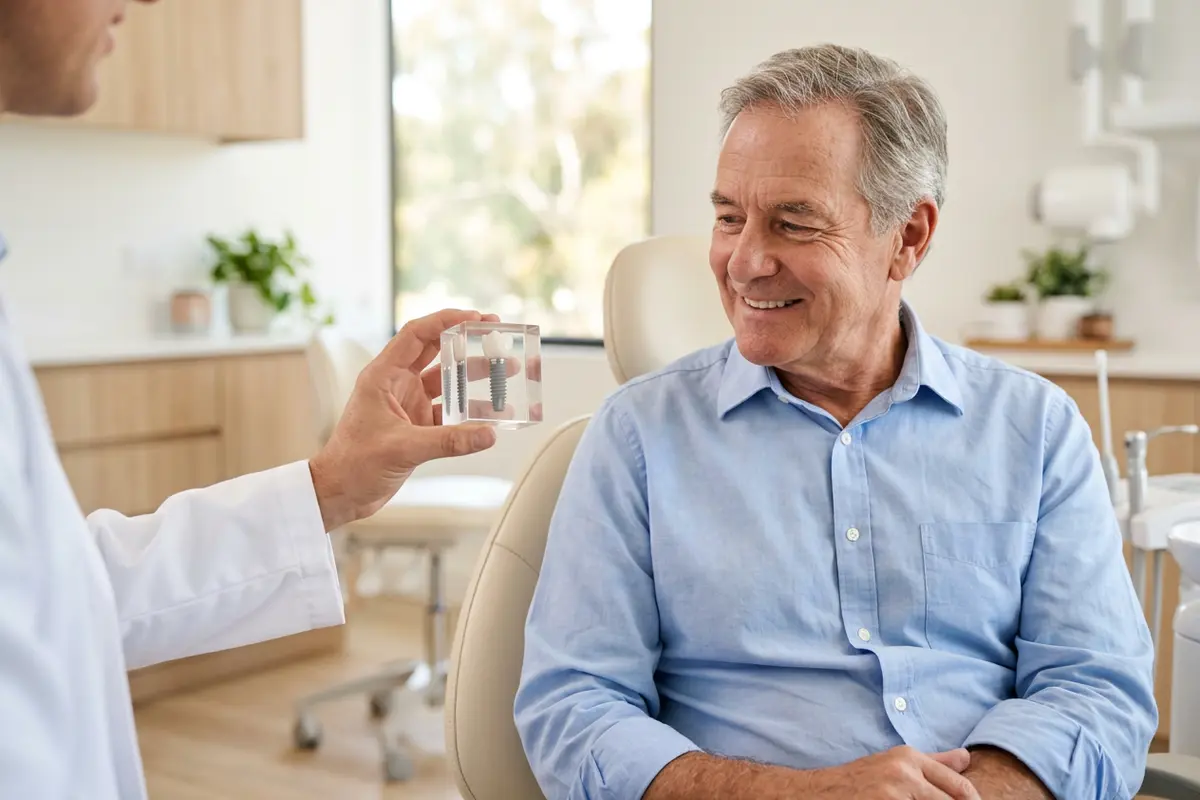
How dental implant rejection happens
True dental implant rejection is rare. The main signs of a problem are a loose implant, bleeding gums and pus. If you notice any of them, the implant needs to be examined at once. After placement, bone gradually grows onto the surface of the implant. This process is called osseointegration, and it takes several months.
Early failure
the first months after placement
- the bone has not formed a firm contact with the implant
- the implant stays loose
- causes: infection, overheated bone, early loading, smoking, lack of bone
Late problems
months or years later
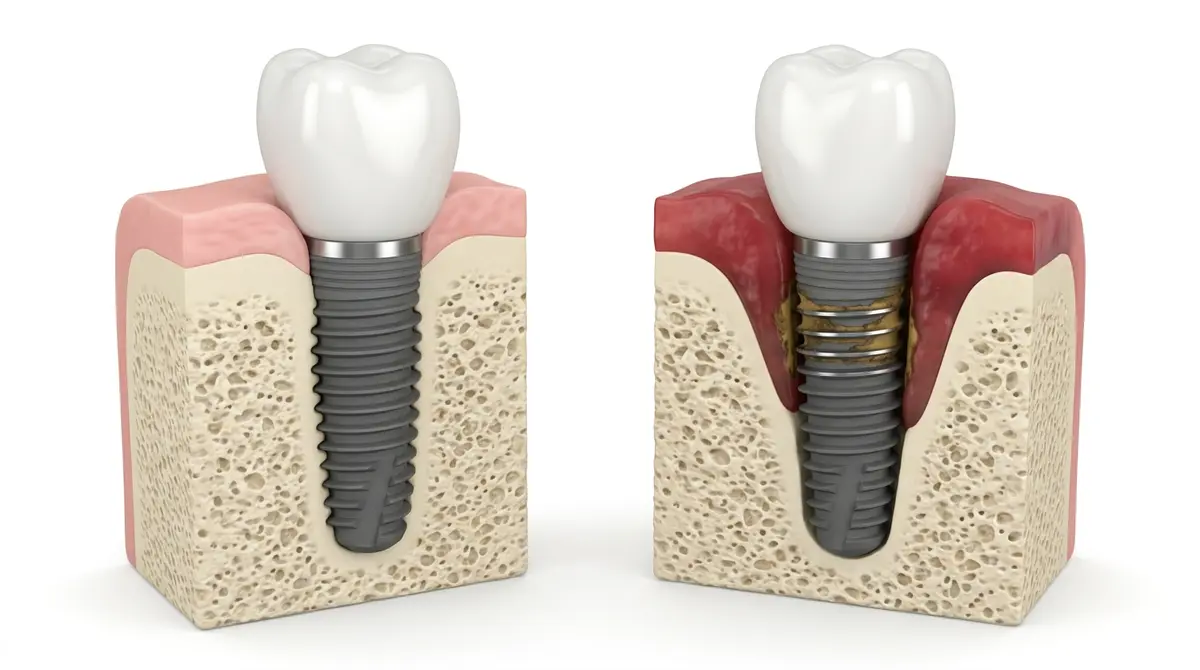
- at first only the gum around the implant is inflamed, this is mucositis
- the inflammation can reach the bone, and then peri implantitis develops
- the main cause is plaque around the implant
Why dental implant failure happens
Causes of early dental implant failure:
- infection in the surgical area;
- overheating of the bone during drilling, or weak fixation of the implant in the bone right after placement;
- loading that is too early;
- smoking;
- diabetes with poorly controlled glucose levels;
- too little bone, or bone of low quality.
Late problems are more often linked to plaque. According to international studies, peri implantitis is more common in people who have had periodontitis (gum inflammation with bone loss), in smokers, and in those with diabetes or alcohol misuse.
Peri implantitis
Peri implantitis is inflammation of the tissues around an implant with bone loss. According to international studies, it is common. The review combined 20 studies that used the same 2017 diagnostic criteria:
The figures differ between studies because they depend on the diagnostic criteria. Peri implantitis starts unnoticed. That is why follow-up visits and professional cleaning matter so much.
At consultations we are often asked where the inflammation comes from if the implant does not hurt. In our practice, there is usually no pain at an early stage, and the only sign can be bleeding when cleaning. So we advise you not to wait for pain and to show us such a gum straight away.
How to tell that a dental implant has not taken
Signs to show your doctor
- the implant or the crown on it is loose
- pain when biting or tapping
- bleeding and swelling of the gum around the implant
- discharge of pus
- the gum recedes and metal becomes visible
- an unpleasant taste near the implant
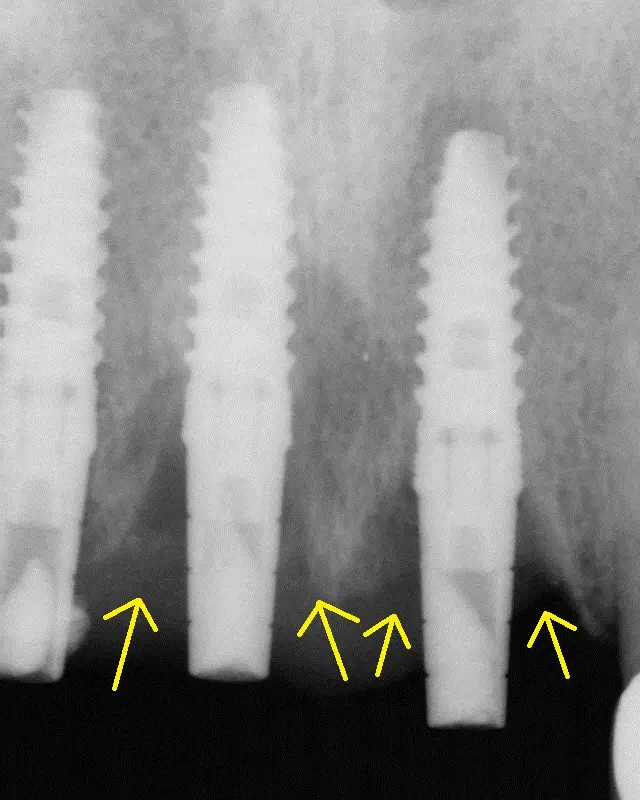
On an X-ray we assess the level of bone around the implant. At the examination we check its mobility and the depth of the pocket (the gap between the gum and the implant). We measure it with a thin probe and note whether blood appears. Then we compare the new image with the original one taken after the prosthetics. This shows whether the bone level is stable. That is why the first images are worth keeping.
In our practice, patients do not always tell a loose crown from a loose implant. If the crown has come loose, it does not yet mean that the implant has lost its connection with the bone. We first check which part is moving. Before the examination we advise you not to tighten the crown yourself or to chew on that side.
See a doctor urgently if
- facial swelling is increasing;
- you have a raised temperature;
- pain is getting worse instead of easing a few days after surgery;
- the implant wobbles.
Slight swelling and soreness in the first days after placement are a normal reaction. This article is for general information only and does not replace a doctor's consultation.
Is the gum around your implant bleeding or swollen?
We will check the implant and compare the X-rays.
How to stop dental implant rejection
How we treat dental implant rejection depends on when the problem is found.
| Condition | What is happening | Possible treatment |
|---|---|---|
| Mucositis | only the gum is inflamed, the bone is not affected | professional cleaning and better home care |
| Early peri implantitis | bone loss is beginning | cleaning of the implant surface and control of the inflammation; sometimes additional methods are needed |
| Advanced peri implantitis | significant bone loss | surgical treatment with cleaning and, if possible, bone restoration |
| Loose implant | the implant does not hold in the bone | removal, healing and a decision on placing a new implant |
- What is happening
- only the gum is inflamed, the bone is not affected
- Possible treatment
- professional cleaning and better home care
- What is happening
- bone loss is beginning
- Possible treatment
- cleaning of the implant surface and control of the inflammation; sometimes additional methods are needed
- What is happening
- significant bone loss
- Possible treatment
- surgical treatment with cleaning and, if possible, bone restoration
- What is happening
- the implant does not hold in the bone
- Possible treatment
- removal, healing and a decision on placing a new implant
A loose implant does not grow back into the bone. In this case we carry out dental implant removal. A new implant can often be placed successfully after healing, if there is enough bone. Implant rejection and a failed dental implantation do not mean that you have to give up on this method altogether.
Prices at Cristi Dent
Prices are valid as of 19 October 2026. We draw up the treatment plan from the tomography. More on the page dental implant removal.
Planning a new implant?
Book a free consultation: we will assess the bone and suggest a plan.
Where to get help
Mobility, bleeding gums or pus can mean dental implant rejection. Do not wait: book an examination. We carry out implant placement. We plan it from X-rays and tomography at Cristi Dent. Then we monitor how the implant takes and how recovery goes.
Sources
- Peri-implant diseases and conditions: Consensus report of workgroup 4 of the 2017 World Workshop on the Classification of Periodontal and Peri-Implant Diseases and Conditions. J Clin Periodontol. 2018;45 Suppl 20:S286-S291 pubmed.ncbi.nlm.nih.gov/29926491
- The prevalence of peri-implant mucositis and peri-implantitis based on the world workshop criteria: A systematic review and meta-analysis. J Dent. 2025;160:105914 pubmed.ncbi.nlm.nih.gov/40523497
- Prevalence, incidence, systemic, behavioral, and patient-related risk factors and indicators for peri-implant diseases: An AO/AAP systematic review and meta-analysis. J Periodontol. 2025;96(6):587-633 pubmed.ncbi.nlm.nih.gov/40489307
Images in the article: X-ray of implants with peri implantitis: Partynia, CC BY-SA 3.0, Wikimedia Commons.
How to reduce the risk
- give up smoking, or at least do not smoke while the implant heals;
- keep diabetes under control;
- clean your teeth with a brush and choose interdental cleaning aids together with us;
- do not replace the brush and interdental brushes with an irrigator (a device with a jet of water);
- come for professional cleaning, check-ups and follow-up images as prescribed.
What not to do
- waiting for bleeding at the implant to go away by itself;
- chewing hard food on a fresh implant before the allowed time;
- skipping follow-up visits;
- throwing away the images taken after placement.
Frequently asked questions
True dental implant rejection is rare, and most implants last for many years. Inflammation around an implant is more common. According to international studies, peri implantitis is linked to smoking, diabetes and past periodontitis.
An immune rejection, like that of a transplanted organ, is not typical for an implant. The causes of failure are infection, overload, smoking, lack of bone and plaque around the implant.
There is no set day: fusion with the bone takes several months. If pain and swelling increase or pus appears, we advise you to come at once. You do not need to wait until the end of the first week. We check stability before fitting the crown and at later check-ups.
Often yes. After a loose implant is removed, we wait for healing. If there is enough bone, or it can be restored, we place an implant again.
Show us the implant at the first signs. A follow-up tomography is free for our patients.
ARTICLE AUTHOR
Carries out implant placement and full rehabilitation of the dental arches, works with complex cases and with bone and gum restoration. Accompanies the patient from planning to the final result.