Apicoectomy in Chișinău
Apicoectomy is a minor operation in which the doctor removes the tip of a tooth root together with the area of inflammation or a cyst, and seals the canal from the root end. It is done when inflammation at the root does not clear after root canal treatment, or when retreatment through the crown is not possible. Root end resection lets you keep your own tooth instead of having it extracted.
What is apicoectomy
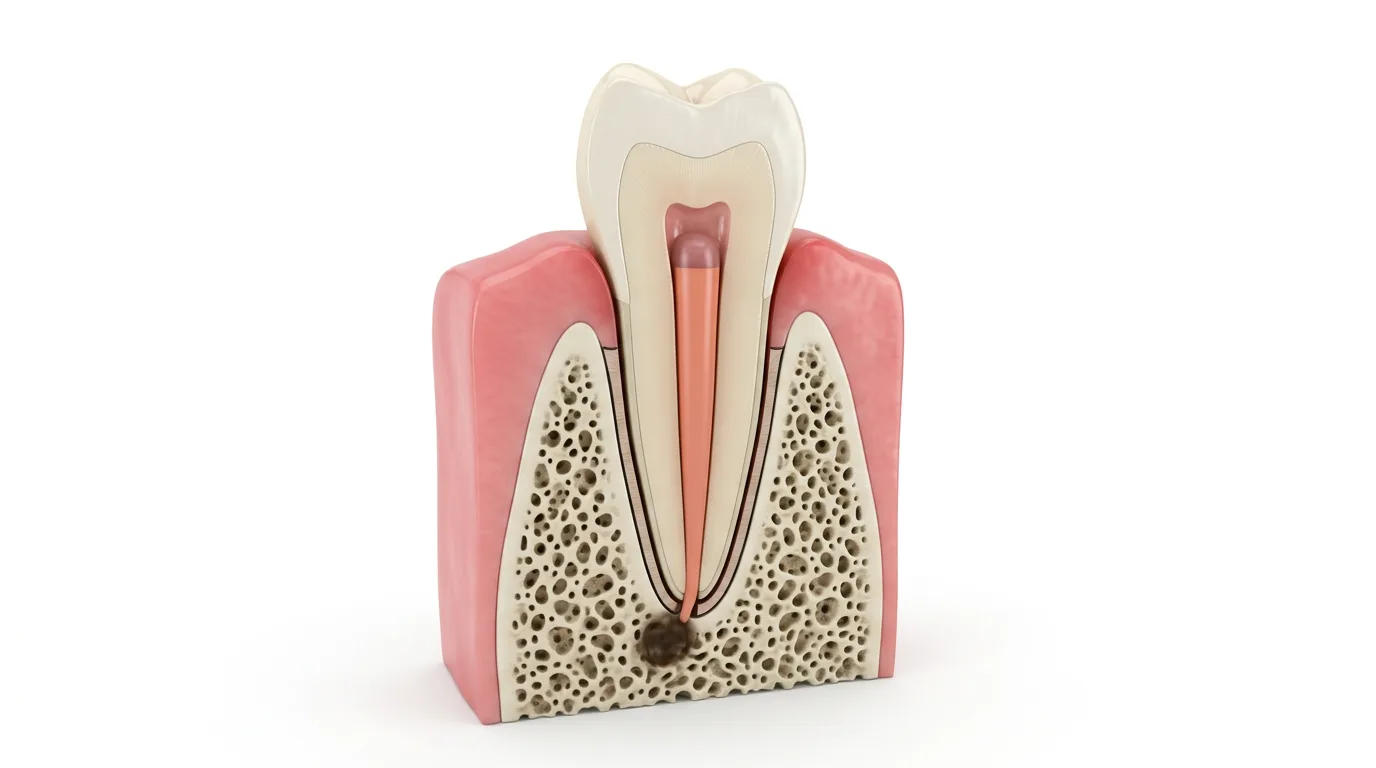
Inside the root of a tooth runs a canal that ends at the tip with a tiny opening. If bacteria stay in the canal, inflammation develops around the root tip: first a small focus, and in time a granuloma (a small sac of inflamed tissue) or a cyst (a fluid-filled cavity). This is usually treated through the crown of the tooth, where the doctor cleans and fills the canals again. Sometimes that is not enough, for example when the canal is badly curved, an instrument has broken inside it, the root tip has complex branching, or the lesion (the area of infection) does not shrink after good treatment.
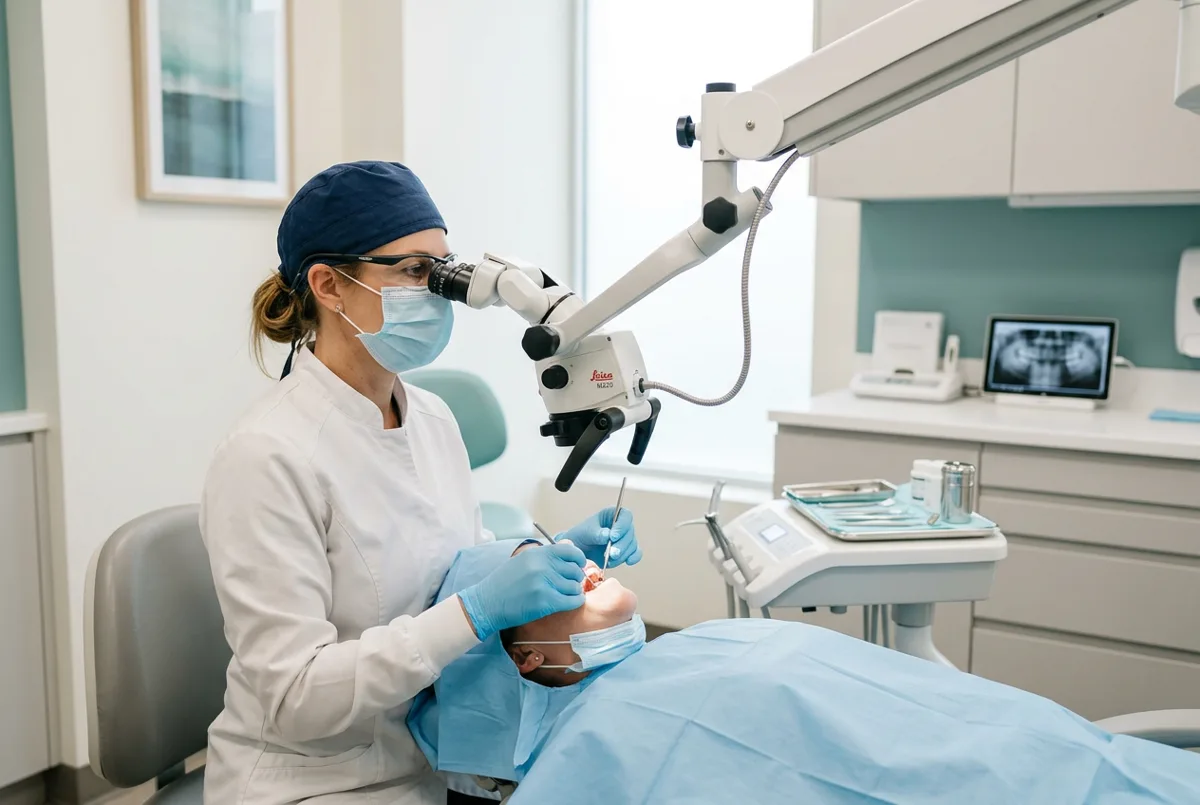
In that case we approach the root tip from the bone side. Through a small cut in the gum, the doctor opens the area above the root, removes the inflamed tissue, cuts off a few millimetres of the root tip, where bacteria most often remain, and seals the canal with a special material. This modern approach is called endodontic microsurgery: the work is done under magnification with fine instruments. Working under magnification lets us clean and seal the root tip precisely.
When root end resection is needed
We recommend root end resection if a lesion at the root remains on the X-ray after root canal treatment or retreatment, if the tooth aches from time to time or a fistula (a small gum boil) appears, if a broken instrument fragment is left in the canal and cannot be removed, and in the case of a cyst at the root tip. It is also chosen when the tooth has a good crown or post, and taking it off for retreatment would be risky or pointless.
Before the operation, the doctor always assesses the tooth on images. A periapical X-ray shows the lesion at the root tip, and for complex anatomy we order a CBCT scan (3D dental scan) to see the size of the lesion, the thickness of the bone and the distance to neighbouring roots, the nerve and the sinus. We usually try root canal retreatment through the crown first, and move to surgery only if it is not possible or has not worked. In our practice both approaches have their place, and the choice depends on the individual case.
Root end resection, retreatment or extraction: what to choose
Option | When it suits | What the patient gets |
|---|---|---|
Root canal retreatment | the canals can be reached through the crown | treatment without a cut |
Root end resection | the lesion persists and access through the crown is not possible | the tooth is saved and the crown stays on |
Extraction and an implant | the root is cracked, badly damaged or short | the tooth is replaced with an implant |
Apicoectomy is not the first step but the next one, when conservative methods have run out. It suits a tooth whose root is long and strong enough and which has good support in the bone. If the root is cracked, or what remains after the tip is removed would be too short, saving the tooth makes no sense.
When another solution is possible
If the tooth cannot be saved, we extract it and place a dental implant instead. If the inflammation at the root is small and the canals can be retreated, no operation is needed. We decide after the examination and images, and we discuss all the options with you, including their cost and timing.
Results of root end resection
Instead of being extracted, it keeps working with its own root and crown.
The inflamed tissue and the cyst that were destroying the bone are removed.
New bone gradually forms where the lesion was.
The operation is done from the root side, and the crown stays in place.
Apicoectomy cost
Removal of the root tip with the area of inflammation and sealing of the canal.
Repeat treatment of the canals through the crown of the tooth.
A digital image to assess the root and the lesion.
If the canals need retreatment before the operation, it costs 2,500 MDL, or 2,000 MDL under a crown. Diagnostics are paid separately: a periapical X-ray is 100 MDL and a CBCT scan 700 MDL, while a follow-up CBCT scan is free for our patients. A consultation with a specialist doctor is free. The final plan with the total is fixed before treatment starts.
How the operation is done
The doctor studies the periapical X-ray or CBCT scan and assesses the lesion, the length of the root and the condition of the bone.
The operation is performed under local anaesthesia chosen for you individually.
A small cut is made in the gum and the area of bone above the root tip is opened.
The inflamed tissue or cyst is removed and the root tip is cut off.
The canal is filled from the root end with a special material so that bacteria cannot reach the bone.
The gum is stitched, the stitches come out after a few days, and healing is monitored on X-rays.
How long healing takes
The bone where the lesion was recovers gradually, over several months, so the doctor invites you for a follow-up X-ray to make sure the lesion is getting smaller. On the first day after the operation, apply cold to the cheek in short sessions, eat soft cool food on the other side, do not rinse your mouth vigorously and do not smoke. You can brush your teeth, carefully avoiding the area of the stitches. If the swelling grows after the third day, you develop a fever or there is any discharge, contact us straight away.
What happens if a lesion at the root is left untreated
It gradually enlarges and destroys the bone around the root.
Chronic inflammation can turn acute, with pain and swelling.
A large lesion reaches the roots of the teeth next to it.
In advanced cases the tooth can no longer be saved and has to be extracted.
Who does the treatment
Our general dentist Alexandru Borovețchi performs apicoectomy. He also carries out root canal treatment and retreatment and has completed courses in repeat endodontics. For more on root canal treatment, see our endodontics section. If the examination shows the tooth cannot be saved, we discuss the treatment plan with the surgeon who performs tooth extraction and the implant placement that follows.
Apicoectomy questions
Don't put off your dental health


