updated
November 12, 2026
...
read
Zirconia Crown vs Porcelain Fused to Metal: What to Choose

In short, which is better: a zirconia crown vs porcelain fused to metal (PFM)? There is no universal answer. A PFM crown has been proven over decades and has a large margin of strength. Zirconia looks more natural and contains no metal. But on zirconia crowns with a ceramic veneering the top layer chips more often. We make the choice based on the tooth, the bite and what matters more to you.
What is a zirconia crown? How it differs from a PFM crown in structure
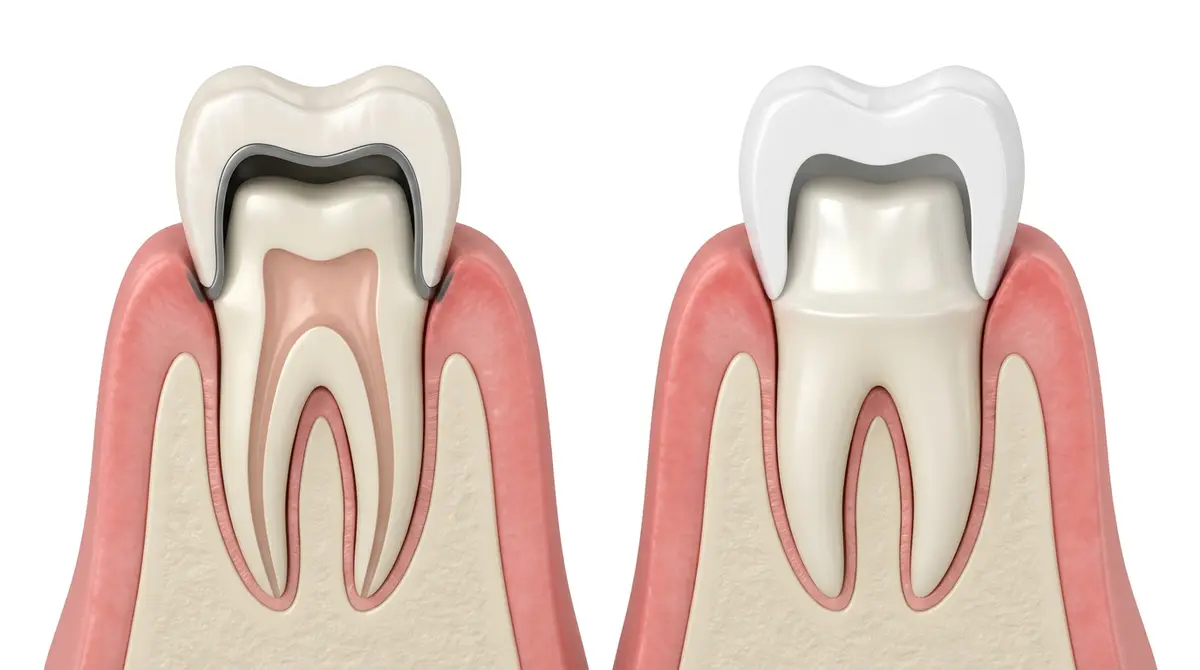
A porcelain-fused-to-metal (PFM) crown consists of a metal framework onto which ceramic is applied in layers and fired. A zirconia crown is made of zirconium dioxide, a dense white material. It is either milled whole from zirconia, and such a crown is called monolithic, or veneering ceramic is applied to a zirconia framework.
Zirconia vs PFM in one table
| Feature | PFM | Monolithic zirconia | Veneered zirconia |
|---|---|---|---|
| Framework | metal | all zirconia | zirconia |
| Look | less lifelike, metal does not let light through | natural, slightly more matt | closest to enamel |
| At the gum line | when the gum recedes, a dark line can show | no dark line | no dark line |
| Weak point | more of the tooth is ground down, rare sensitivity to alloys | less long-term data | chipping of the veneer |
| Where it suits better | chewing teeth, long bridges | chewing teeth | front teeth |
- PFM
- metal
- Monolithic zirconia
- all zirconia
- Veneered zirconia
- zirconia
- PFM
- less lifelike, metal does not let light through
- Monolithic zirconia
- natural, slightly more matt
- Veneered zirconia
- closest to enamel
- PFM
- when the gum recedes, a dark line can show
- Monolithic zirconia
- no dark line
- Veneered zirconia
- no dark line
- PFM
- more of the tooth is ground down, rare sensitivity to alloys
- Monolithic zirconia
- less long-term data
- Veneered zirconia
- chipping of the veneer
- PFM
- chewing teeth, long bridges
- Monolithic zirconia
- chewing teeth
- Veneered zirconia
- front teeth
How zirconia crowns are made
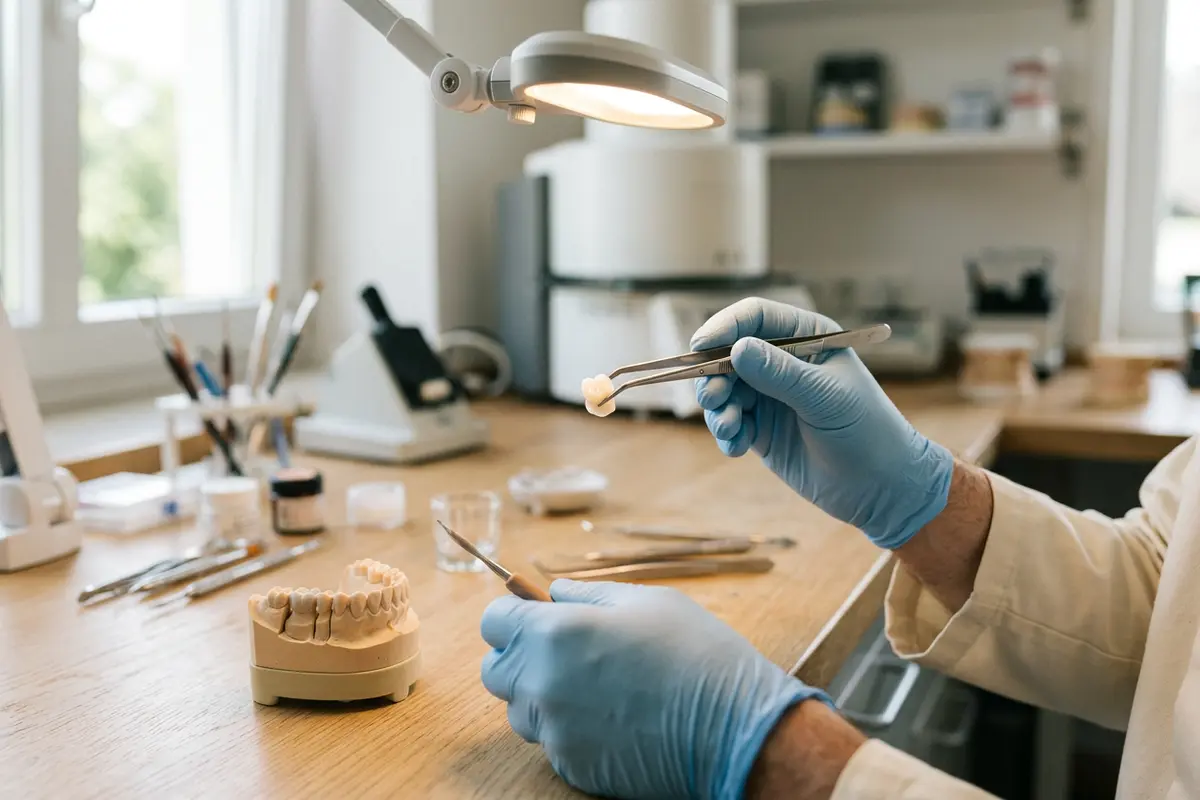
We scan the tooth or take an impression, and then the crown is designed on a computer. A milling machine cuts it from a blank using CAD/CAM technology, that is, from a digital model without hand modelling. After that the crown is sintered in a furnace, where the material gains its strength. Then it is stained and glazed to match the neighbouring teeth.
PFM crown vs zirconia: pros and cons of a PFM crown
Patients often ask us about a ceramic vs zirconia crown. Usually they mean a PFM crown, also called a metal-ceramic crown, against zirconia.
Pros
- a long record of clinical use and well-studied behaviour
- high strength, including on chewing teeth
- suitable for long bridges
Cons
- metal does not let light through, so the crown looks less lifelike
- when the gum recedes, a dark line can show at the edge
- more of the tooth has to be ground down
- some people are sensitive to alloys
Zirconia vs porcelain crown: drawbacks and strengths of zirconia
Zirconia contains no metal, is well tolerated by the tissues and gives a natural colour at the gum. However, it has limitations. In a zirconia vs ceramic crown comparison, international studies show that the vast majority of single crowns of both kinds are still in service after 5 years. Zirconia is slightly behind.
In this review, zirconia crowns were more often lost because of chipping of the veneering ceramic. The second reason is debonding, when the crown comes off the tooth. So for chewing teeth we do not recommend veneered zirconia as a first choice, based on our own experience and this review. Monolithic zirconia has no veneer that can chip. It has come into wider use since the review. There are fewer long-term observations of it than of PFM crowns.
There is one more feature: in the moist environment of the mouth, zirconia can slowly age. This is called low-temperature degradation. According to international studies, the material is still being improved to resist it. That is why the quality of the blank and the precise processing of the crown matter to us.
Zirconia crowns on chewing teeth
On chewing teeth, strength comes first. Monolithic zirconia suits them well, and aesthetics are secondary. For front teeth we more often suggest veneered zirconia or glass ceramic (a highly translucent material, for example E.max).
At consultations we are often asked to place zirconia on all teeth, because it is whiter and has no metal. On chewing teeth, strength and wall thickness matter more than colour. This is what we see in practice. If a person grinds their teeth in sleep (this is called bruxism), the veneer chips more often. Then we choose monolithic zirconia or PFM and advise a protective night guard.
Not sure which crown to choose?
We will choose the material for your specific tooth and bite.
PFM vs zirconia crowns on implants
Both kinds can be placed on an implant. PFM crowns on implants have been used for a long time, and zirconia crowns on implants are valued for their aesthetics at the gum. We make the decision together: the surgeon and the prosthodontist (a specialist in dental prosthetics) take into account the position of the implant and the load on it.
How a crown is placed

The procedure is almost the same for both kinds.
Tooth preparation
We treat the tooth and, if needed, the root canals.
Shaping
Under local anaesthesia we shape the tooth for the crown.
Impressions and a temporary crown
We take an impression or scan the tooth, and a temporary crown protects it.
Try-in
We check the fit and adjust the bite.
Fixing
We fix the crown with dental cement.
More on this: the PFM crown and the E.max crown, made of glass ceramic for front teeth.
Crown prices at Cristi Dent
Prices are valid as of 19 October 2026. We give the final cost after the examination and planning. More on the zirconia crown page.
When to see a doctor about a crown
- the crown is loose or has come off;
- a piece of ceramic has chipped off;
- the tooth under the crown hurts or the gum around it is inflamed;
- an unpleasant smell has appeared at the edge of the crown.
The information in this article is for general guidance and does not replace a consultation with a dentist.
Want to compare the options on your tooth?
Book a free consultation: we will show you which crown suits you.
Where to go for help
To choose a crown, start with a consultation with a prosthodontist. We place both zirconia crowns and PFM crowns at Cristi Dent in Chișinău. We will choose the material for your tooth, your bite and your expectations.
Sources
- Sailer I et al. All-ceramic or metal-ceramic tooth-supported fixed dental prostheses (FDPs)? A systematic review of the survival and complication rates. Part I: Single crowns (SCs). Dent Mater. 2015;31(6):603-623 pubmed.ncbi.nlm.nih.gov/25842099
- Huang B et al. Advances in zirconia-based dental materials: Properties, classification, applications, and future prospects. J Dent. 2024;147:105111 pubmed.ncbi.nlm.nih.gov/38866229
How to choose
We more often suggest zirconia for front teeth and for people who cannot tolerate metals. A PFM crown remains a reliable option for chewing teeth and bridges. We make the final choice of material after the examination: we look at the bite, bruxism, and the condition of the tooth and gum.
While a temporary crown is in place
- do not chew anything hard or sticky on it;
- clean the area as carefully as your own teeth;
- if the temporary crown comes off, keep it and call us.
Frequently asked questions
There is no universal best. For front teeth aesthetics matter more, for chewing teeth strength. So we choose the crown for the tooth, the bite and the condition of the gum.
Zirconia crowns cost more. At Cristi Dent a PFM crown on a tooth costs 2,000 MDL and a zirconia crown from 3,000 MDL. We give the exact amount after the examination and planning.
For chewing teeth we place strong constructions: PFM or monolithic zirconia. If a tooth is missing, it can be replaced with an implant and a crown, or with a bridge.
According to international studies, more than 90% of single crowns of both kinds are still in service after 5 years. In our practice, the lifespan depends on hygiene, the bite and habits such as grinding the teeth.
A consultation with a specialist doctor at Cristi Dent is free. We will assess the tooth, the bite and the gum and suggest a suitable material.
ARTICLE AUTHOR
Works in prosthetic dentistry: crowns, bridges and complex restoration after partial or complete tooth loss. Monitors the functional and aesthetic result of the treatment.