updated
November 12, 2026
...
read
Tooth Abscess: Pus on the Gum and When It Is Urgent

A tooth abscess is a collection of pus at the root of a tooth or in the gum, caused by a bacterial infection. It does not go away on its own. Even if the abscess has burst and the pain has eased, the source in the root remains and will sooner or later make itself felt again. We advise seeing a dentist as soon as possible. If your face is swollen, come the same day, and if you have difficulty breathing or swallowing, call 112 straight away.

How urgent is it?
Use your symptoms as a guide
Emergency care
Call 112 or go to the emergency department
- difficulty breathing, speaking or swallowing
- swelling that is growing fast, especially under the tongue or on the neck
- a swollen or painful eye, or a change in vision
- the mouth barely opens
See a dentist today or tomorrow
Book the earliest appointment
- swelling of the cheek or gum
- throbbing pain when biting
- fever and enlarged lymph nodes
- a bump with pus on the gum
See a dentist within the next few days
Do not put the visit off
- a pimple on the gum that comes and goes
- an unpleasant taste near one tooth
- a darkened tooth that was treated in the past
This information is for general guidance and does not replace an examination by a doctor.
Gum boil vs abscess: are they the same thing?
Gum boil is an everyday word for a gum abscess. People use it for swelling of the cheek or gum that comes from a bad tooth. At appointments we often use it ourselves, because everyone understands it. The medical name depends on what is happening in the tissues: it is either periostitis, that is, inflammation of the periosteum (the membrane covering the bone), or an abscess, a localised collection of pus. For you, the general rule matters more: a gum boil means the infection has already spread beyond the tooth.
Where the pus comes from
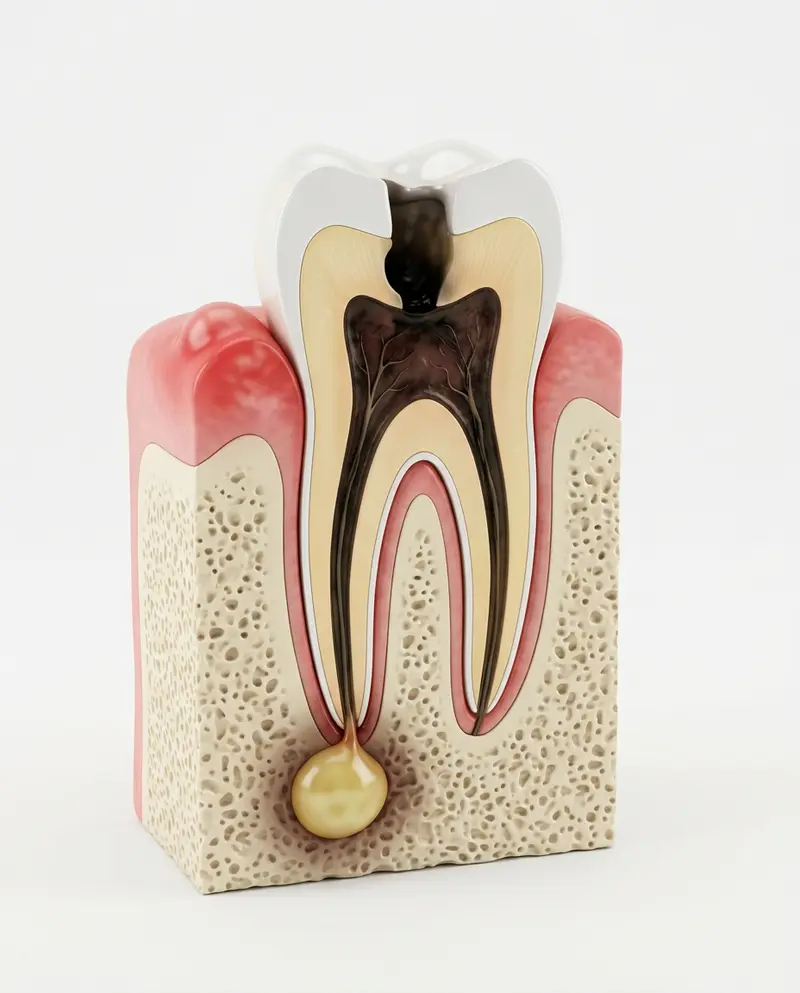
A tooth abscess most often develops like this. Deep caries reaches the nerve, and the nerve becomes inflamed and dies. Bacteria travel through the root canal to the tip of the root. In time a collection of pus forms there, in the bone. It presses on the surrounding tissues and causes throbbing pain. We describe the early signs of cavities you should not ignore in a separate article.
A dental abscess can also have other causes. In our practice, these are:
- gum disease with deep pockets, that is, gaps between the tooth and the gum;
- a wisdom tooth that has only partly erupted;
- an injury to the tooth or gum;
- radiotherapy or chemotherapy.
How a gum boil starts
First the tooth hurts, either dully or with a throbbing pain, and it is worse when you bite. Then other signs appear:
- redness and swelling of the gum, sometimes a bump with pus;
- a swollen cheek or jaw;
- an unpleasant taste in the mouth;
- sensitivity to hot and cold;
- difficulty opening the mouth;
- pain when chewing;
- a raised temperature;
- enlarged lymph nodes in the neck.
It can also be the other way round. A chronic tooth root abscess may hardly hurt if the pus finds a way out through a fistula, a thin channel to the surface of the gum. A person can live for years with a pimple on the gum that comes and goes. At appointments we often hear: I have an abscess on my gum, but it does not hurt, so it is not serious. But the bone around the root may be breaking down all this time.
Can a gum boil burst on its own?
It can. Pus sometimes breaks through the gum, and the pain drops sharply because the pressure in the infected area falls. It seems that the body has coped by itself. But this is not recovery: the source of the infection stays in the root, and after a while everything starts again. Never lance or squeeze the abscess yourself, as it is easy to push the infection deeper.
Has the abscess burst and the pain gone?
This is not recovery. We will find the source of the infection before it destroys the bone.
Tooth abscess: why it is dangerous
This is not just a swollen cheek. The main danger is where the infection can spread: into the deep spaces of the neck (layers of loose tissue between the muscles), towards the sinuses and, in rare cases, deeper. According to international studies, teeth are among the main sources of deep neck infections.
The share of dental causes differs between hospitals, but the conclusion is the same: you cannot leave this kind of infection untreated. According to international studies, Ludwig's angina spreads quickly and can block the airway. So if swelling under the tongue or on the neck is growing fast, we ask you not to come to the dental clinic but to call 112 straight away.
What can be mistaken for a gum boil
Other conditions can also cause swelling that looks like a tooth abscess, so we make the diagnosis after an examination and an X-ray, not from a photo on the internet.
| Condition | How it differs |
|---|---|
| Periodontal abscess | pus in a deep pocket next to a loose tooth; the nerve of the tooth is often still alive |
| Pericoronitis | inflammation of the gum over a wisdom tooth that has only partly erupted |
| Infected cyst | a focus at the root that grew painlessly for a long time and then flared up |
| Salivary gland inflammation | swelling linked to eating, the teeth usually do not hurt |
| Lymph node inflammation | a firm, painful lump under the jaw, which may appear after a cold |
- How it differs
- pus in a deep pocket next to a loose tooth; the nerve of the tooth is often still alive
- How it differs
- inflammation of the gum over a wisdom tooth that has only partly erupted
- How it differs
- a focus at the root that grew painlessly for a long time and then flared up
- How it differs
- swelling linked to eating, the teeth usually do not hurt
- How it differs
- a firm, painful lump under the jaw, which may appear after a cold
Is a gum boil contagious?
Not in the usual sense. It is an infection from your own tooth, not a disease that spreads through the air or via cutlery and dishes. You do not need to isolate yourself from your family. But do not touch the pus or try to squeeze it out.
How a gum boil is treated at the dentist
The aim of treatment is to remove the pus and the source of the infection. The order is as follows.
Examination and X-ray
An X-ray shows us the tooth causing the problem and the size of the infected area.
Drainage
This means letting the pus out. Under local anaesthesia, a small incision is made or the tooth is opened so that the pus can drain.
Treating the source
We carry out root canal treatment or, if the tooth cannot be saved, extract it.
Antibiotics when indicated
We prescribe them when the infection has spread or there are general symptoms. Without drainage and treatment of the tooth, they do not solve the problem.
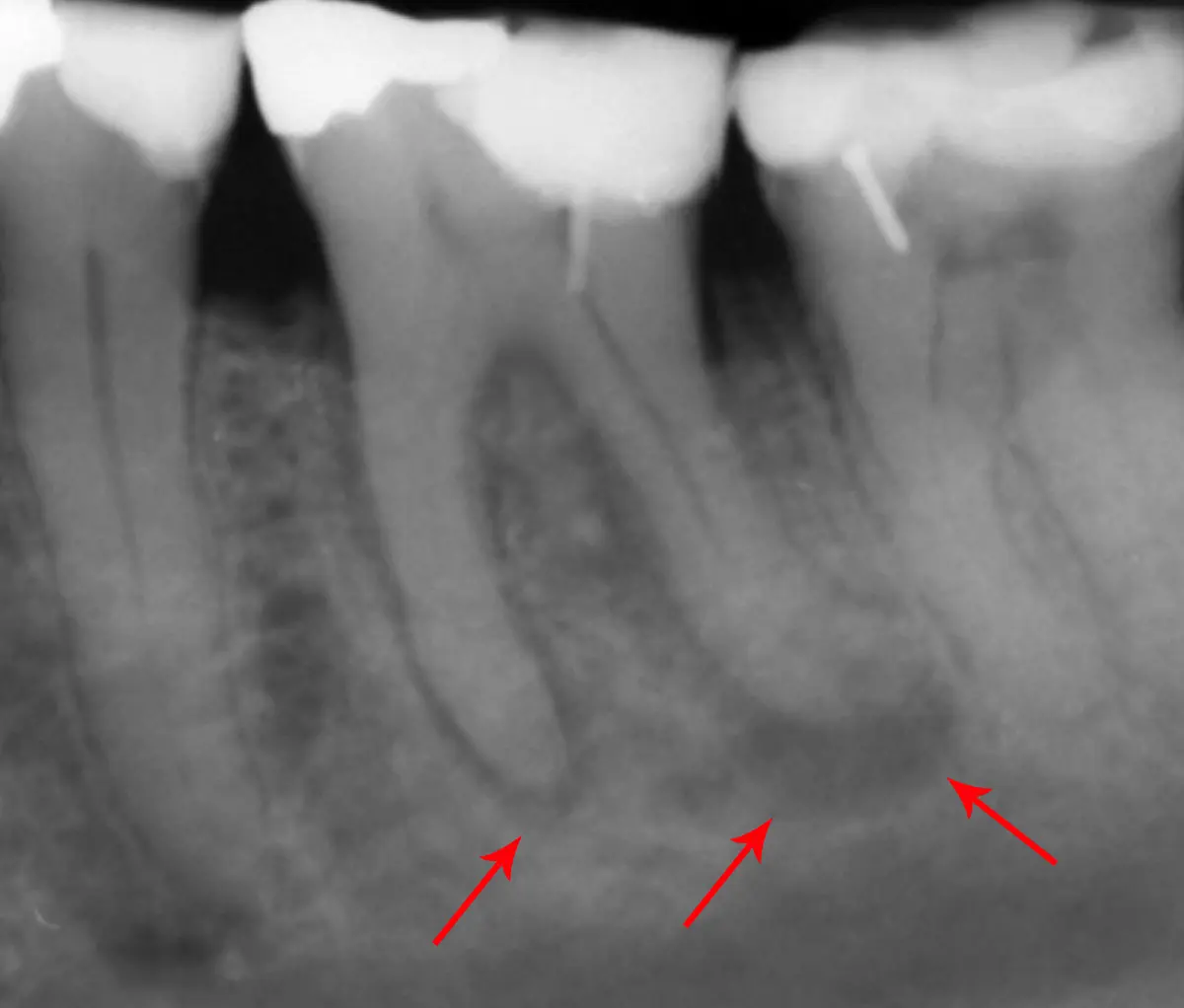
At appointments we are often asked whether you can simply take a course of antibiotics and skip the dentist. In our practice, the swelling may go down after tablets, but the infected area in the root remains and the inflammation returns. According to international studies, the source of the infection must first be removed locally, and antibiotics are indicated when it has spread or there are general symptoms. That is why the pus must be drained first and the tooth treated.
Can you pull a tooth with an abscess, or can it be saved?
The tooth can often be saved. If the root and the surrounding bone allow it, we save the tooth: we clean the canals, seal them tightly and then restore the tooth with a filling or a crown. We extract the tooth when it is badly damaged or the infection does not clear after treatment.
How long does treatment for a gum boil take?
Relief after drainage usually comes quickly. Full tooth treatment can take several visits. The exact timing depends on the tooth and on how far the inflammation has spread, and we give it after the examination.
What you can do before the visit
- take a painkiller strictly as directed
- eat soft food and avoid chewing on the sore side
- brush your teeth gently with a soft brush
What not to do
- apply heat or a warm compress to the cheek
- lance or squeeze the abscess
- take antibiotics "just in case" without a prescription
Treatment prices at Cristi Dent
Prices are valid as of 19 October 2026. We give the final plan and cost after the examination and X-ray. More on the root canal treatment page.
Found pus on your gum or have a swollen cheek?
Book the earliest appointment: we will examine the tooth and draw up a treatment plan.
Where to go for help
If you have noticed pus on the gum or a swollen cheek, see a dentist the same day or the next. We carry out the examination and X-ray at Cristi Dent in Chișinău, find the tooth causing the problem and draw up a treatment plan. More on the oral surgery page.
Sources
- NHS. Dental abscess www.nhs.uk/conditions/dental-abscess
- StatPearls. Oral Facial Infection of Dental Origin: A Guide for the Medical Practitioner www.ncbi.nlm.nih.gov/books/NBK542165
- StatPearls. Dental Emergencies www.ncbi.nlm.nih.gov/books/NBK589664
- Isankova et al. Deep neck infections, series of 111 patients. Otolaryngol Pol. 2025 pubmed.ncbi.nlm.nih.gov/39812309
- StatPearls. Ludwig Angina pubmed.ncbi.nlm.nih.gov/29493976
- Bridwell R, Gottlieb M, Koyfman A, Long B. Diagnosis and management of Ludwig's angina: an evidence-based review. Am J Emerg Med. 2021;41:1-5 pubmed.ncbi.nlm.nih.gov/33383265
- Cope AL et al. Systemic antibiotics for symptomatic apical periodontitis and acute apical abscess in adults. Cochrane Database Syst Rev. 2024;5:CD010136 pubmed.ncbi.nlm.nih.gov/38712714
Images in the article: close-up X-ray of a tooth with an abscess: Coronation Dental Specialty Group, CC BY-SA 3.0, Wikimedia Commons.
Why you should not wait
At appointments we keep hearing the same story: the abscess burst at night, the pain was gone by morning, and the visit was cancelled. A few weeks later the swelling returns, sometimes worse, and by then the bone around the root has had time to suffer. Treating it on time is almost always simpler.
What to bring to your appointment
To help us understand your situation faster, bring:
- a list of the medicines you take;
- old X-rays of this tooth, if you have them;
- notes on when the swelling and the fever appeared.
Frequently asked questions
The pus can burst and the pain can ease, but the source of the infection stays in the tooth. That is why the inflammation usually returns and the bone around the root keeps breaking down.
Under local anaesthesia, the tooth is opened or a small incision is made so that the pus can drain. Then the cause is dealt with: the canals are treated, or a tooth that cannot be saved is extracted.
Without treatment, the infection can spread to the tissues of the face and neck, and in rare cases this is life-threatening. Rapidly increasing swelling, a high temperature, or difficulty swallowing or breathing call for emergency care.
No, we do not advise it. Heat can speed up the spread of the infection. Before the visit you can take a painkiller as directed and eat soft food.
Show it to a dentist the same day or the next. We at Cristi Dent will find the tooth causing the problem and draw up a treatment plan.
ARTICLE AUTHOR
Carries out the surgical stages of treatment, including tooth extraction, preparation for implantation and tissue restoration in complex clinical situations.