updated
November 12, 2026
...
read
Pericoronitis: Inflamed Gum Over a Wisdom Tooth
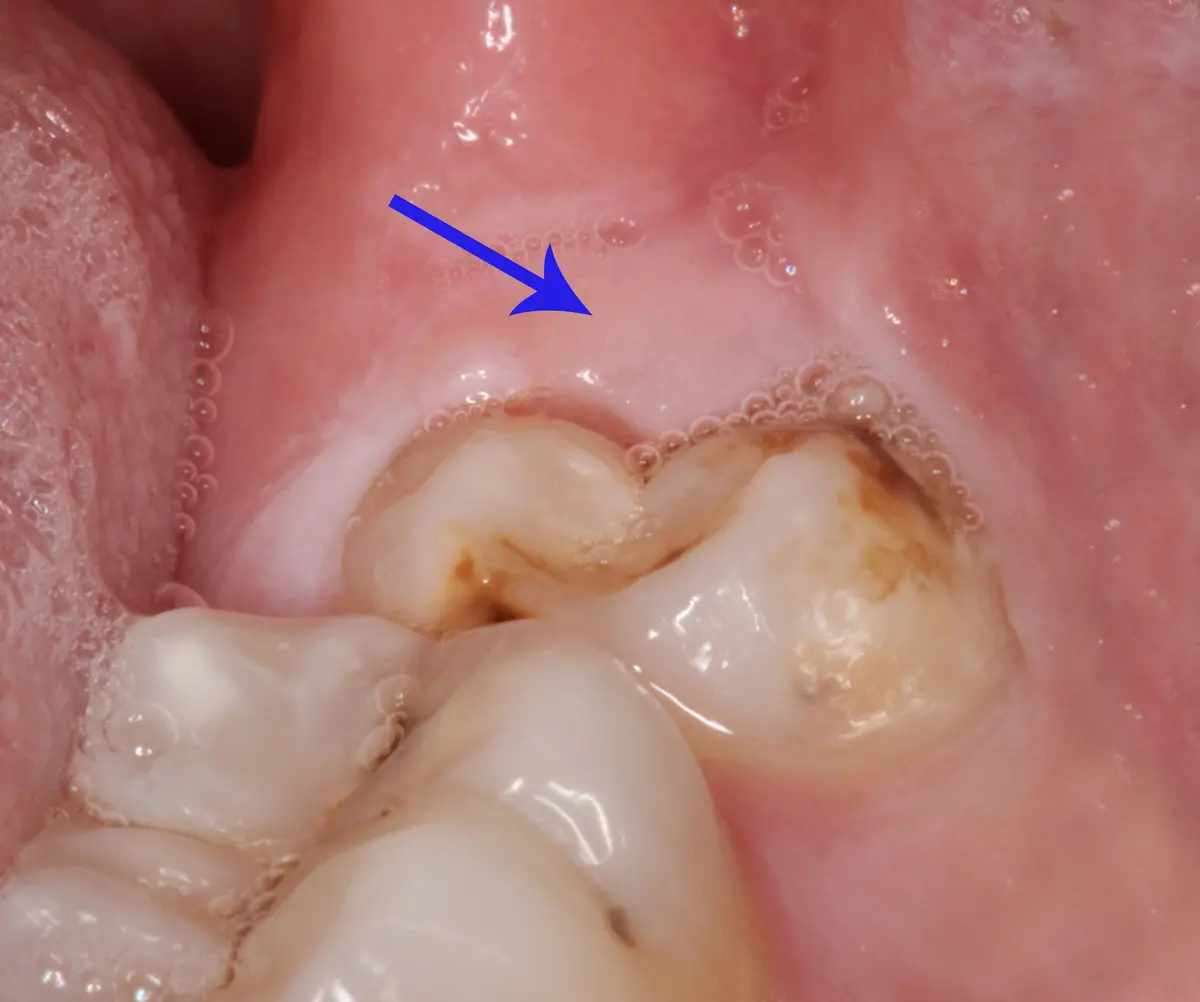
Pericoronitis is inflammation of the gum that partly covers a tooth as it comes through, most often a lower wisdom tooth. Food and bacteria get trapped under this hood, and it is almost impossible to clean at home. A mild episode can sometimes be relieved by rinsing the pocket at the clinic. But until the cause is removed, the inflammation comes back.

Causes of pericoronitis: why the inflammation starts there
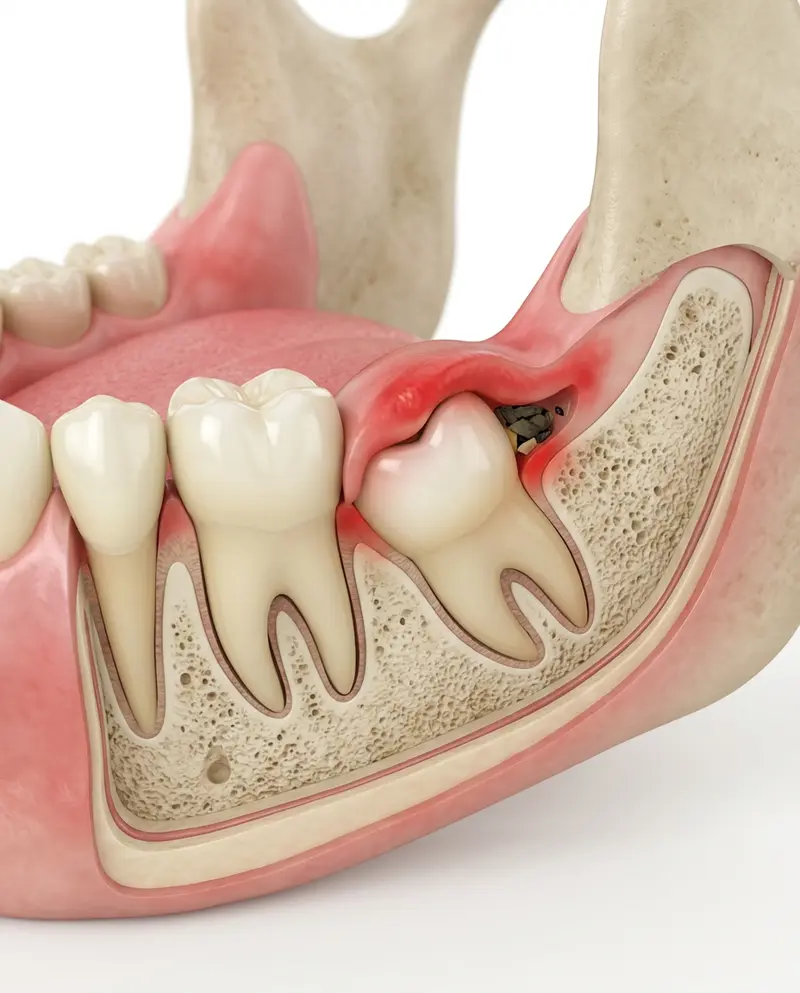
Pericoronitis is inflammation of the gum over a wisdom tooth that has not fully come through. When a wisdom tooth cannot break through the gum fully, a fold of mucous membrane, the hood, stays over it. A narrow pocket forms between the hood and the crown, which is the visible part of the tooth. Food remains collect there, and bacteria multiply in the tight space that a brush cannot reach. The gum can also be injured by the upper wisdom tooth, which presses on the hood when the jaws close.
In our practice, and according to international studies, a flare-up most often starts during a cold or a period of stress. We pay attention to these factors:
- a cold and other upper respiratory tract infections;
- stress and tiredness;
- weakened immunity, including poorly controlled diabetes.
Painful swollen gum around wisdom tooth: pericoronitis symptoms
- pain at the very back of the lower jaw, worse when chewing
- swelling and redness of the gum over the tooth
- an unpleasant taste and bad breath
- pus from under the hood
- difficulty opening the mouth wide
- pain when swallowing, sometimes spreading to the ear
Acute pericoronitis begins suddenly and the symptoms are marked: within a day or two the pain becomes severe, the gum swells and chewing on that side is uncomfortable. The chronic form drags on for months with periods of mild discomfort. A person gets used to it until the next flare-up.
Wisdom tooth gum infection: why pericoronitis is dangerous
The main risk is the spread of infection. From a localised focus it can pass into the fascial spaces, that is, the loose tissue under the tongue, under the jaw, around the throat and in the cheek. This is how the complications of pericoronitis develop: the swelling grows, swallowing becomes difficult, the voice changes and the mouth opens less and less. According to a clinical review, without treatment such an infection can become life-threatening, because the swelling interferes with breathing.
When you need urgent help
- you have difficulty swallowing, breathing or speaking;
- swelling of the cheek or neck is increasing quickly;
- you can hardly open your mouth;
- you have a raised temperature and marked weakness;
- the pain is getting worse and painkillers do not help.
The information in this article is for general information and does not replace an examination by a doctor.
Can pericoronitis go away on its own
A flare-up can subside, especially if the tooth finally comes fully through into the right position. But if there is no room for the tooth, the hood stays, and the inflammation is likely to come back. That is why we ask you to come in even when the pain has eased.
Patients often come to us only after a second or third episode. Each time the pain was relieved with rinses and tablets, and it seemed that everything had cleared up. On the X-ray in such cases we often see a tilted tooth with no room to come through.
Does the gum behind your last tooth hurt?
We will rinse the pocket, relieve the inflammation and use an X-ray to assess whether the tooth has room.
How we make the diagnosis
We examine the gum, assess how far the mouth opens and check whether the lymph nodes are enlarged. Then we always take a dental X-ray. The image shows the position of the wisdom tooth, whether it has enough room and whether it is damaging the neighbouring tooth.
How to treat pericoronitis of a wisdom tooth
We choose the approach by the severity of the inflammation and by whether the tooth has a chance of settling into place.
Rinsing the pocket
We rinse the space under the hood with an antiseptic and gently clean it.
Pain relief
We choose the medicine and the dose with your health and other medicines in mind.
Antibiotics where indicated
We prescribe them only if there are signs that the infection is spreading.
A decision on the tooth
When the inflammation has subsided, we decide whether to keep the tooth or remove it. Sometimes it is enough to excise the hood, that is, remove the excess fold of gum.
Keep the wisdom tooth or remove it
| Situation | What we advise |
|---|---|
| The tooth is in the right position and can come through | excise the hood and monitor |
| There is no room for the tooth and it is tilted | remove it once the acute inflammation has subsided |
| Episodes keep recurring | remove the tooth without waiting for a new flare-up |
| The tooth is damaging the neighbouring second molar (the last tooth before the wisdom tooth) | remove it |
- What we advise
- excise the hood and monitor
- What we advise
- remove it once the acute inflammation has subsided
- What we advise
- remove the tooth without waiting for a new flare-up
- What we advise
- remove it
When episodes recur, removal is a considered recommendation, not a random one. According to international studies, quality of life improves after it in people with mild symptoms of pericoronitis. According to international studies, inflammation of the tissues behind the second molar is also found markedly less often after removal.
At our clinic such procedures belong to oral surgery.
What you can do before your visit
- gently clean the area with a soft brush
- eat soft food and chew on the other side
- take painkillers strictly as directed
What not to do
- warm the cheek
- try to squeeze out the pus or cut the gum
- take antibiotics left over from earlier treatment
- cancel your visit because the pain has eased for a while
Prices at Cristi Dent
Prices are valid as of 19 October 2026. We determine how complex the removal is from the X-ray. More on the page wisdom tooth extraction.
Does pericoronitis keep coming back?
We will tell you whether it is time to remove the wisdom tooth.
Where to go
If the gum over your wisdom tooth hurts, see a dentist within the next few days, or at once if there is swelling and difficulty swallowing. We carry out wisdom tooth extraction in Chișinău. We do it after an X-ray assessment, when there is no point in keeping the tooth.
Sources
- Kwon G, Serra M. Pericoronitis. StatPearls. 2022 pubmed.ncbi.nlm.nih.gov/35015436
- Bataineh AB et al. The predisposing factors of pericoronitis of mandibular third molars in a Jordanian population. Quintessence Int. 2003;34(3):227-231 pubmed.ncbi.nlm.nih.gov/12731606
- Bradshaw S et al. Quality of life outcomes after third molar removal in subjects with minor symptoms of pericoronitis. J Oral Maxillofac Surg. 2012;70(11):2494-2500 pubmed.ncbi.nlm.nih.gov/22868034
- Dicus C et al. Second molar periodontal inflammatory disease after third molar removal in young adults. J Oral Maxillofac Surg. 2010;68(12):3000-3006 pubmed.ncbi.nlm.nih.gov/20970905
- NHS. Wisdom tooth removal www.nhs.uk/conditions/wisdom-tooth-removal
- StatPearls. Oral Facial Infection of Dental Origin: A Guide for the Medical Practitioner www.ncbi.nlm.nih.gov/books/NBK542165
Image in the article (an inflamed gum over a wisdom tooth): Coronation Dental Specialty Group, CC BY-SA 3.0, Wikimedia Commons.
A typical story
In our practice, this story repeats itself for many people. The pain went away after a few days of rinsing. A couple of months later, during a cold or a period of stress, everything came back stronger. For us such a repeat is a signal to settle the question of the tooth once and for all.
Pericoronitis in brief
- inflammation of the gum over an erupting tooth;
- most often around the lower wisdom teeth;
- can be acute or chronic;
- comes back unless the cause is removed.
Frequently asked questions
Acute symptoms sometimes subside, but while the tooth is partly covered by the hood, bacteria collect under it again. That is why the inflammation usually returns.
In our practice, with timely treatment the acute period passes within a few days. If the cause is not removed, the attacks repeat. With a swollen cheek and difficulty opening the mouth, recovery takes longer.
Food remains and plaque are trapped under it. This causes repeated inflammation, decay in the neighbouring tooth and a risk of the infection spreading, when it becomes hard to open the mouth or swallow.
Usually we first relieve the acute inflammation: we rinse the pocket and, if necessary, prescribe medicines. We plan the removal once the swelling and pain have eased. We determine the final timing after the examination and the X-ray.
Show us the tooth at Cristi Dent. From the X-ray we will tell you whether it has room or is better removed.
ARTICLE AUTHOR
Carries out surgical procedures in complex clinical cases and oversees the stages of treatment within comprehensive rehabilitation.