updated
November 12, 2026
...
read
Receding Gums: Why Tooth Roots Become Exposed

Receding gums, or gum recession, means that the gum edge has moved down and part of the root is exposed. Most often it is caused by a hard toothbrush used with heavy pressure, gum inflammation and thin gums. The tooth looks longer, the neck (the part of the tooth at the gum edge) reacts to cold, and dark triangles appear between the teeth. It does not go away on its own. But we can stop the process, and in some cases cover the exposed root surgically.

Receding gums: why tooth roots become exposed
Receding gums mean that the gum edge has moved down and part of the root is exposed. Here we explain why gums recede and roots become exposed: signs, causes, gentle brushing and gum grafting. Explained by our periodontists (gum specialists) at Cristi Dent in Chișinău.
How common are receding gums?
Far more common than it seems. According to international studies, at least one area of gum recession is found in these groups:
The gum most often recedes on the outer, cheek side of the teeth.
Why are my gums receding? Causes of gum recession
There are several causes, and they usually add up. In our practice, and according to international studies, these factors are linked to gum recession:
- injury from brushing: a toothbrush that is too hard, heavy pressure, horizontal sawing movements;
- gum inflammation and periodontitis, inflammation of the tissues around the tooth that destroys the bone beneath the gum;
- teeth that sit outside the dental arch, where the bone and gum are thin from the start;
- smoking;
- naturally thin gums, or tension from the frenula of the lips.

Gum recession occurs with both good and poor hygiene. In some people the gum is worn away by an over-enthusiastic toothbrush, in others it retreats because of inflammation. At appointments we often see people who brush very carefully, with a hard brush and firm pressure, and are surprised that their gums still recede. In such cases we start not with talk of surgery but with a change of toothbrush and brushing technique.
Brushing that protects the gums
- a toothbrush with soft bristles
- light pressure, no force
- sweeping movements from the gum towards the edge of the tooth
- floss or interdental brushes for the gaps between teeth
Brushing that wears the gums away
- a hard toothbrush, because it seems to clean better
- heavy pressure
- horizontal sawing movements
- abrasive whitening pastes every day
Gum recession after braces
Braces do not cause gum recession in everyone, but there is a risk. According to international studies, gum recession is found more often after orthodontic treatment, especially if the incisors were tilted forward and the gum is thin. The gum edge can drop when a tooth is moved so that it comes out beyond the bony wall. That is why before braces we assess the thickness of the tissues, and if there is a risk, we plan the treatment together with a periodontist.
Gum recession after dental implants
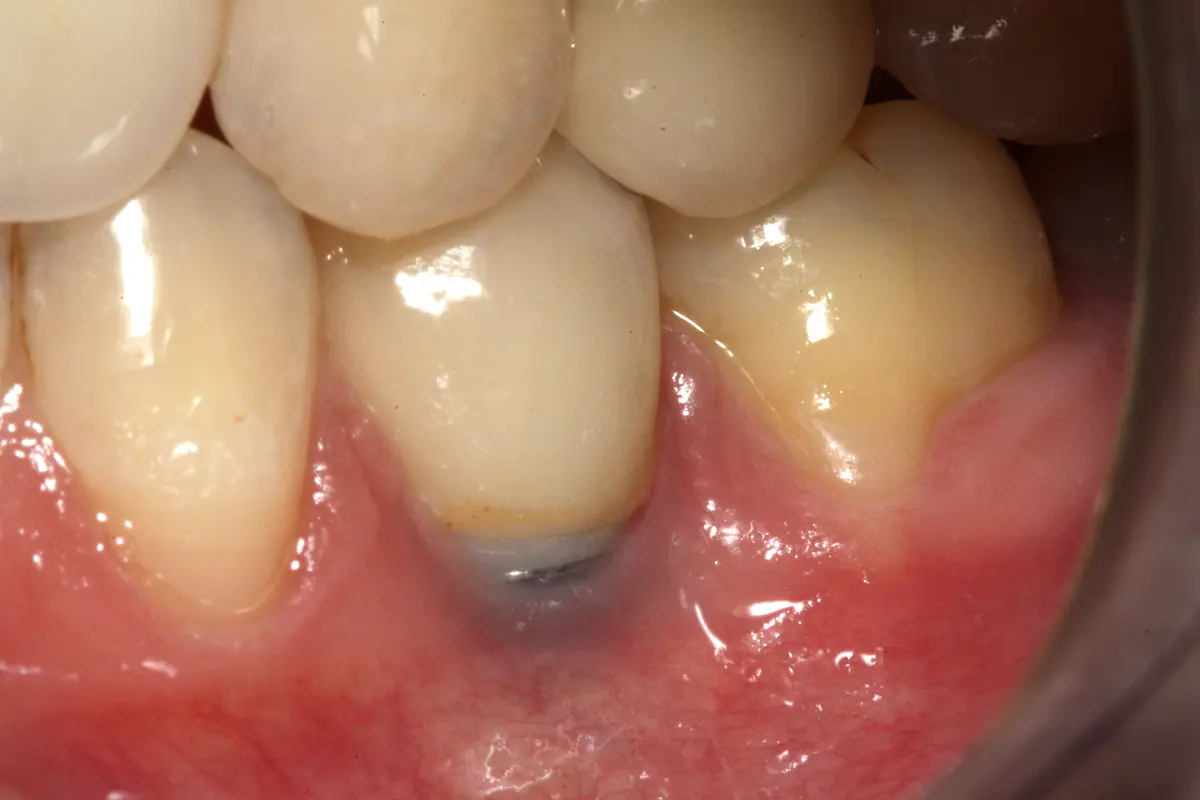
The gum can also recede around an implant and expose the metal part. Sometimes the tissues are simply thin. Sometimes it is a sign of peri-implantitis, inflammation around the implant with loss of bone. According to international studies, with this condition the gum is inflamed, bleeds or discharges pus. The pockets, that is, the gaps between the tooth and the gum, become deeper, or the edge of the mucosa moves down. An X-ray shows the bone loss. If you have these signs, we ask you to come for an examination without delay.
How to tell if your gums are receding
How do you know if your gums are receding? Look for these signs.
- a tooth looks longer than its neighbours, and its neck has changed colour
- sensitivity to cold and sour food, or when brushing
- dark triangles have formed between the teeth
- the edge of a filling or crown has become visible
- you can feel a step or a notch at the neck of the tooth
Exposed tooth roots are unpleasant not only to look at. The root is covered not by enamel but by a softer tissue. That is why it wears down more easily and is more often affected by caries.
If you are unsure how to know if your gums are receding, compare your teeth with the list above.
When to see a doctor without delay
- the gum is receding fast, over a few months;
- bleeding, pus, swelling;
- a tooth has become loose;
- severe pain from cold that does not go away;
- the gum has receded around an implant.
This information is for general guidance and does not replace an examination by a periodontist.
Do your teeth seem to have become longer?
We will measure the recession and find its cause.
What to do if gums are receding
First, find the cause. We measure the depth of the recession and the pockets, and assess the thickness of the gum, the position of the teeth and the bite. If necessary, we take X-rays. Without this, treatment makes no sense: if the cause is the toothbrush or inflammation, the gum will recede again after grafting.
We record the measurements in your chart. After a few months we compare them with new ones to see whether the process has stopped.
How to stop gums receding
- switch to a soft toothbrush and brush without pressure;
- treat gum inflammation, if there is any;
- give up smoking;
- if necessary, correct the position of the teeth or release the tension of a frenulum.
How to fix gums receding
You cannot bring the gum back with pastes or gels. Toothpastes for sensitive teeth ease the reaction to cold, but they do not lift the gum edge back into place. An exposed root can be covered only surgically. Surgery for gum recession, also called grafting, is carried out under local anaesthesia. We choose the method at the examination.
How an exposed root is covered
| Method | What is done | When it is suitable |
|---|---|---|
| Connective tissue graft | a small piece of dense tissue from the palate is placed under the gum | to cover the root and thicken the gum |
| Free gingival graft | dense tissue from the palate is placed where the gum is thin | when the gum is too thin and keeps receding |
| Flap advancement | your own gum is moved so that it covers the root | for small recessions with enough gum next to them |
- What is done
- a small piece of dense tissue from the palate is placed under the gum
- When it is suitable
- to cover the root and thicken the gum
- What is done
- dense tissue from the palate is placed where the gum is thin
- When it is suitable
- when the gum is too thin and keeps receding
- What is done
- your own gum is moved so that it covers the root
- When it is suitable
- for small recessions with enough gum next to them
The result depends on the depth of the recession, the condition of the bone between the teeth and your habits. According to international studies, in smokers the recession shrinks less after a connective tissue graft, and fewer roots are fully covered. If there is also periodontitis, we first carry out gum disease treatment.
Prices at Cristi Dent
Prices are valid as of 19 October 2026. We decide on the method and extent of grafting after the examination. More on the gum surgery page.
Thinking about gum grafting?
Book a free consultation: we will assess whether the root can be covered.
Where to go for help
If you have noticed that your teeth seem longer or you feel sensitivity near the neck of the tooth, see a periodontist. We carry out gum surgery at Cristi Dent in Chișinău, including grafting for gum recession. We make the decision after assessing the cause and the condition of the bone.
Sources
- Kassab MM, Cohen RE. The etiology and prevalence of gingival recession. J Am Dent Assoc. 2003;134(2):220-225 pubmed.ncbi.nlm.nih.gov/12636127
- StatPearls. Periodontal Disease www.ncbi.nlm.nih.gov/books/NBK554590
- StatPearls. Overview of Periodontal Surgical Procedures www.ncbi.nlm.nih.gov/books/NBK599507
- Peri-implant diseases and conditions: Consensus report of workgroup 4 of the 2017 World Workshop. J Clin Periodontol. 2018;45 Suppl 20:S286-S291 pubmed.ncbi.nlm.nih.gov/29926491
- Cadenas de Llano-Perula M et al. Risk factors for gingival recessions after orthodontic treatment: a systematic review. Eur J Orthod. 2023;45(5):528-544 pubmed.ncbi.nlm.nih.gov/37432131
- Chambrone L et al. The influence of tobacco smoking on the outcomes achieved by root-coverage procedures: a systematic review. J Am Dent Assoc. 2009;140(3):294-306 pubmed.ncbi.nlm.nih.gov/19255173
Images in the article: gum recession at an implant: Coronation Dental Specialty Group, CC BY-SA 3.0, Wikimedia Commons.
Is it the same as periodontosis?
No. In everyday speech, periodontosis usually means periodontitis. Recession can be a symptom of it, but it can also occur in a person with healthy gums, for example because of injury from a toothbrush. We tell these conditions apart at the examination, and our periodontology service deals with them.
Why receding gums are a problem
- an exposed root reacts to cold;
- it is more easily affected by caries and wears down;
- the aesthetics of the smile suffer;
- with severe recession a tooth can lose its support.
Frequently asked questions
In our practice, often yes, if the cause is removed at an early stage. Surgery is needed to cover a root that is already exposed or to thicken gum that is too thin.
No, gum that has been lost does not grow back by itself. But if the cause is removed, for example hard brushing or inflammation, the process can be stopped.
A toothpaste will not put the gum back. Pastes for sensitive teeth reduce the reaction to cold, fluoride protects the root from caries, and low abrasiveness is gentle on exposed areas.
We carry out the operation under local anaesthesia. For a few days afterwards you may feel discomfort in the palate and gum, and we will explain in detail how to ease it.
A consultation with a specialist doctor at Cristi Dent is free. We will find the cause of the recession and tell you whether grafting is needed.
ARTICLE AUTHOR
Works with gum disease and bone tissue restoration, treats inflammation and prepares tissues for implantation and full rehabilitation.