Fiber Post Tooth Restoration in Chișinău
Fiber post tooth restoration uses a thin rod that the doctor fixes inside the root after root canal treatment, so that a filling or the core under a crown has something solid to hold on to. It is needed when little of the visible part of the tooth is left and the restoration has nothing to grip. The procedure is done by our general dentist Alexandru Borovețchi, and afterwards the tooth is restored with a filling or a crown.
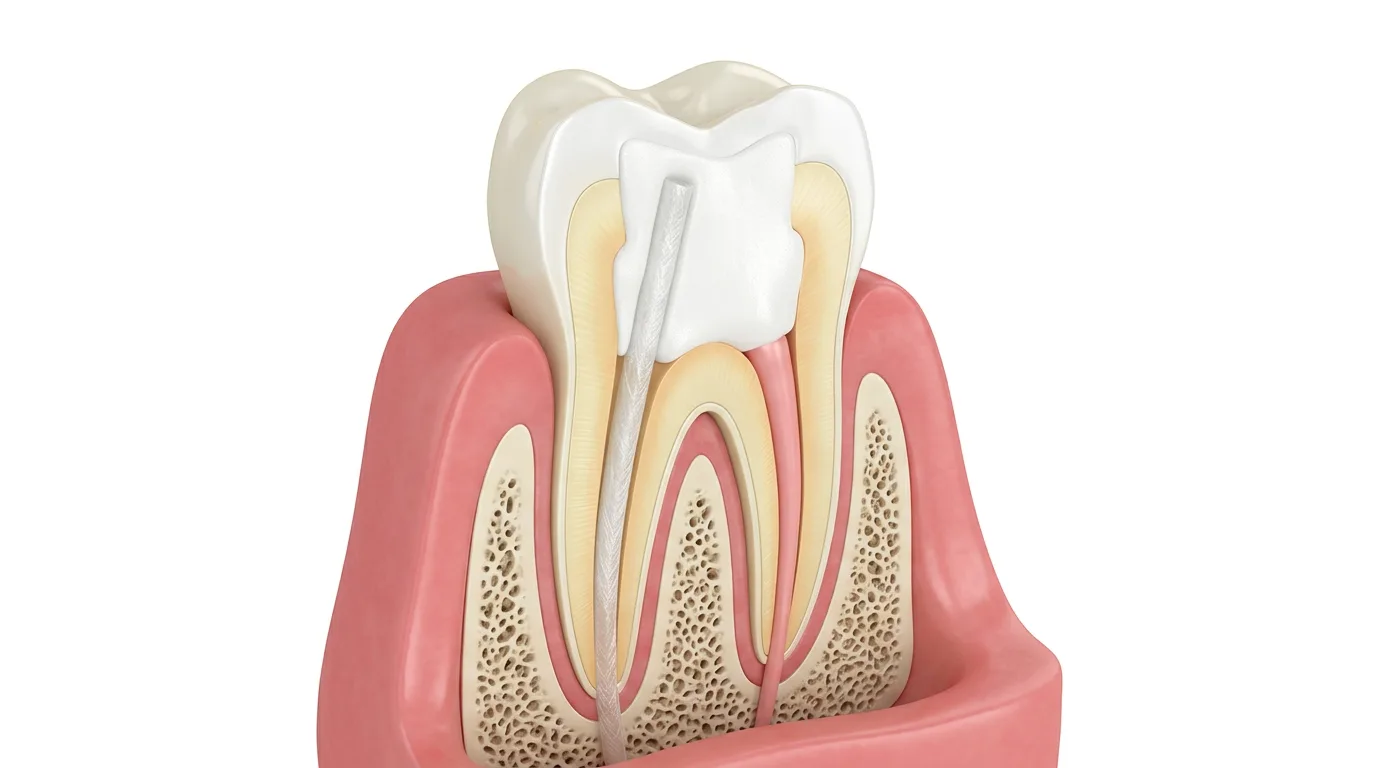
What is a dental post and core
A dental post is a support that goes into the root canal and projects above the root. Around the projecting part the doctor builds up a core, the foundation of the future crown, or restores the tooth straight away with composite material. Together they are called a post and core, and this is the basis of fiber post tooth restoration. The post does not replace the root and does not make the tooth stronger by itself. Its job is to connect the root with the restoration so that it does not break off when you chew.
In the past, dentistry often used metal posts. Today in most cases we choose fiberglass ones: they do not rust, they do not show through ceramic, and they are closer to dentine, the tissue the root is made of, in flexibility. A fiber post is fixed with a special cement that bonds it firmly to the canal walls.
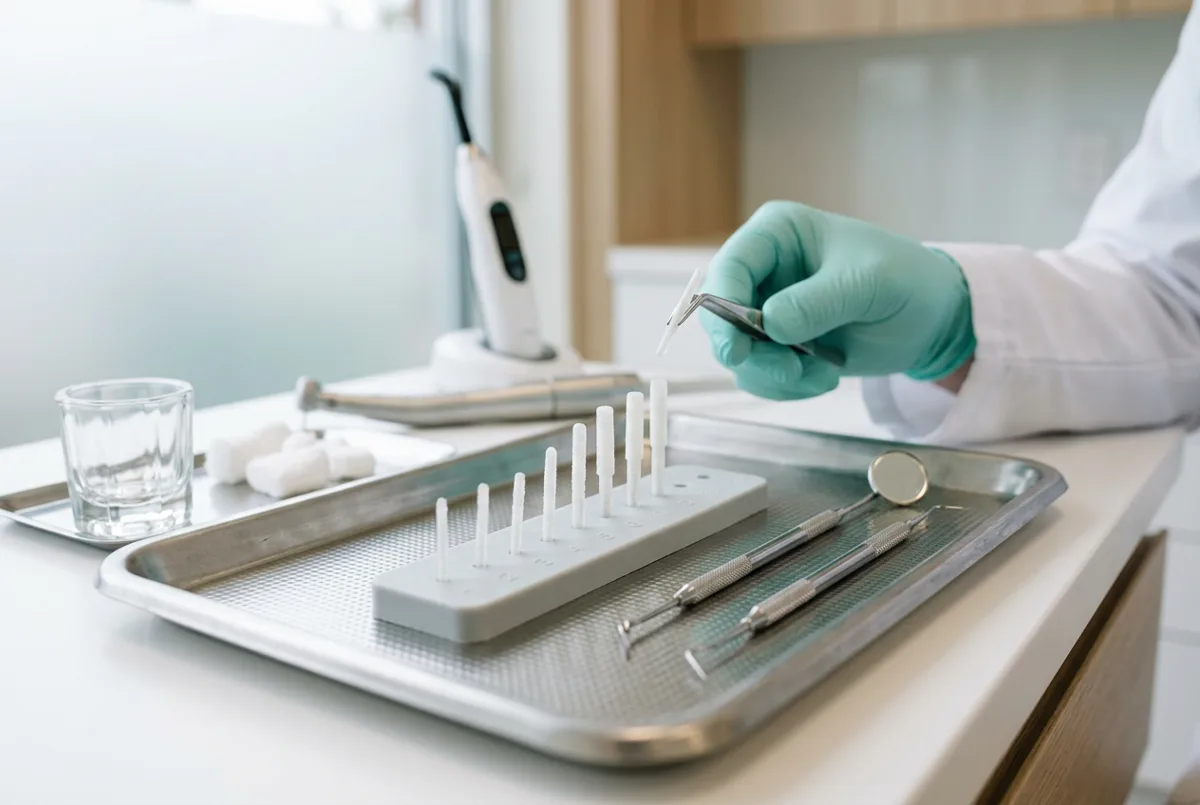
When you need a post in the root of a tooth
We place a post only after high-quality root canal treatment, when the tooth has had its nerve removed and its crown is badly damaged by decay, old fillings, a chip or a crack. The decision depends on how many walls of the tooth have survived. In our experience, a post helps precisely when little of the crown's own tissue is left, and when enough tissue remains the tooth can be restored without one. The decisive factor is the amount of tooth structure that has been preserved.
Before a post and core is built, the doctor always takes an X-ray, to make sure the canals are filled tightly and all the way to the tip, and that there is no inflammation around the root. If the old root filling is outdated or incomplete, we carry out root canal retreatment. A post must never be placed in an inflamed root: it can cause a flare-up and the loss of the tooth.
Fiber post and other options
Option | When it is suitable | Features |
|---|---|---|
Filling without a post | most of the tooth walls are preserved | minimal intervention |
Fiber post + filling | about half of the crown is destroyed | the tooth is restored in one visit |
Fiber post + crown | the crown of the tooth is badly damaged | the post holds the core under the crown |
Extraction and implant | the root is cracked or too short | the tooth cannot be saved |
Most often, fiber post tooth restoration is completed with a crown: it surrounds the tooth on all sides and protects the root from splitting. For chewing teeth this is especially important, because they take the main load. Front teeth can sometimes be restored with a filling on a post if they are not under heavy load, and the colour of the filling is matched to the enamel.
When another solution is possible
If the root is cracked, too short or broken down below the gum line, a post will not help. In that case the tooth is removed and replaced with an implant, as described in the section on dental implants. If the tooth has enough walls left, you do not need a post: it is restored directly with a filling or a crown. The doctor decides which option suits you after the examination and X-ray.
What fiber post tooth restoration gives you
Instead of being extracted, the tooth keeps working with its own root.
The post holds the filling or the core under the crown while you chew.
Fiberglass does not show through ceramic and does not darken.
After the build-up, the tooth can be fitted with a porcelain-fused-to-metal (PFM) or zirconia crown.
Post and core prices
Placing the post in the canal after root treatment.
Cleaning and filling the canals before the post is placed.
The crown that protects the restored tooth.
The price of a post and core starts with the fiber post itself at 1,000 MDL. If the canals have not been treated yet, root canal treatment at 2,000 MDL is added, and retreatment costs 2,500 MDL. Restoration after the post is charged separately: a deep filling costs 1,200 MDL, a PFM crown 2,000 MDL and a zirconia crown 3,000 MDL. After the examination and X-ray, the doctor draws up the full plan with the final total and agrees it with you in advance.
How a post is placed
The doctor assesses the damage to the tooth and the quality of the root filling.
Local anaesthesia is given if needed.
Part of the filling material is carefully removed from the canal to the required depth, leaving a sealed filling at the tip.
A fiber post is selected to match the diameter and length of the canal.
The post is fixed with a special cement that bonds it to the root.
The core for the crown is built up around the post, or the tooth is restored straight away with a filling.
How long it takes
Fiber post tooth restoration, meaning placing the post and building up the core, usually takes one visit of about an hour. If the tooth is restored with a filling, treatment ends there. If a crown is planned, the tooth is prepared and an impression is taken at the same visit or the next one, and a temporary crown is fitted while the permanent crown is made. How long the crown takes depends on the material, and the doctor will tell you at the consultation.
What happens if the tooth is not restored
A root-filled tooth without protection becomes brittle and can crack.
A large filling without support soon breaks off.
Bacteria get into the canals through cracks and gaps.
A split root has to be extracted and replaced with an implant.
Who carries out the treatment
Our general dentist Alexandru Borovețchi carries out fiber post tooth restoration. He treats decay and root canals, and has completed courses in repeat endodontics and in restoring chewing teeth. If the tooth needs a crown after the post and core, treatment is continued by our orthopaedic dentist. You can read more about root canal treatment in the section on endodontics.
After restoration, look after the tooth as you do the others: do not bite nuts or hard objects, brush regularly and have professional cleaning. At check-ups we examine the filling or crown and, if needed, take an X-ray to make sure the root is in good condition.
Frequently asked questions about posts
Don't put off your dental health


