updated
November 12, 2026
...
read
What Are the Types of Dental Fillings: Which Is Best and How Long Does It Last

A filling restores the part of a tooth destroyed by caries (tooth decay) or injury. What are the types of dental fillings? Today the most common is light-cured composite, which hardens under a special lamp. It suits both front and chewing teeth and lasts for years. Glass ionomer cement, which releases fluoride, is used less often, and in some countries amalgam, an alloy with mercury, is still used. Which filling is best depends on the tooth it is for.

Types of dental fillings by lifespan
Fillings are of two kinds:
- a temporary filling is placed for a few days or weeks, for example between visits during root canal treatment;
- a permanent filling is meant to last for years and restores the shape and function of the tooth.
An inlay (a ceramic or composite piece made from a mould of the tooth) and a crown are made in a laboratory. So they are no longer a filling but an indirect restoration.
What are dental fillings made of? Types of filling materials
The three main dental filling materials
| Material | How it looks | Strengths | Weaknesses | Where it is used most often |
|---|---|---|---|---|
| Composite | matches the tooth colour | minimal removal of tooth tissue, bonds to enamel and dentine (the tissue under the enamel) | needs the tooth to be isolated from saliva and careful work; over time secondary caries, that is, new caries at the edge of the filling, can appear at the margin | front and chewing teeth |
| Glass ionomer cement | white, less translucent | releases fluoride, sticks to the tooth, resists moisture | less strong, looks worse | children, near the root, near the gum line, as a lining under another filling |
| Amalgam | grey, metallic | very strong | grey colour, more tooth tissue removed, contains mercury | chewing teeth, in some countries |
- How it looks
- matches the tooth colour
- Strengths
- minimal removal of tooth tissue, bonds to enamel and dentine (the tissue under the enamel)
- Weaknesses
- needs the tooth to be isolated from saliva and careful work; over time secondary caries, that is, new caries at the edge of the filling, can appear at the margin
- Where it is used most often
- front and chewing teeth
- How it looks
- white, less translucent
- Strengths
- releases fluoride, sticks to the tooth, resists moisture
- Weaknesses
- less strong, looks worse
- Where it is used most often
- children, near the root, near the gum line, as a lining under another filling
- How it looks
- grey, metallic
- Strengths
- very strong
- Weaknesses
- grey colour, more tooth tissue removed, contains mercury
- Where it is used most often
- chewing teeth, in some countries
Dental composite fillings are made from a mixture of polymer and fine particles of glass or ceramic. The composite is applied in layers and cured with a lamp.
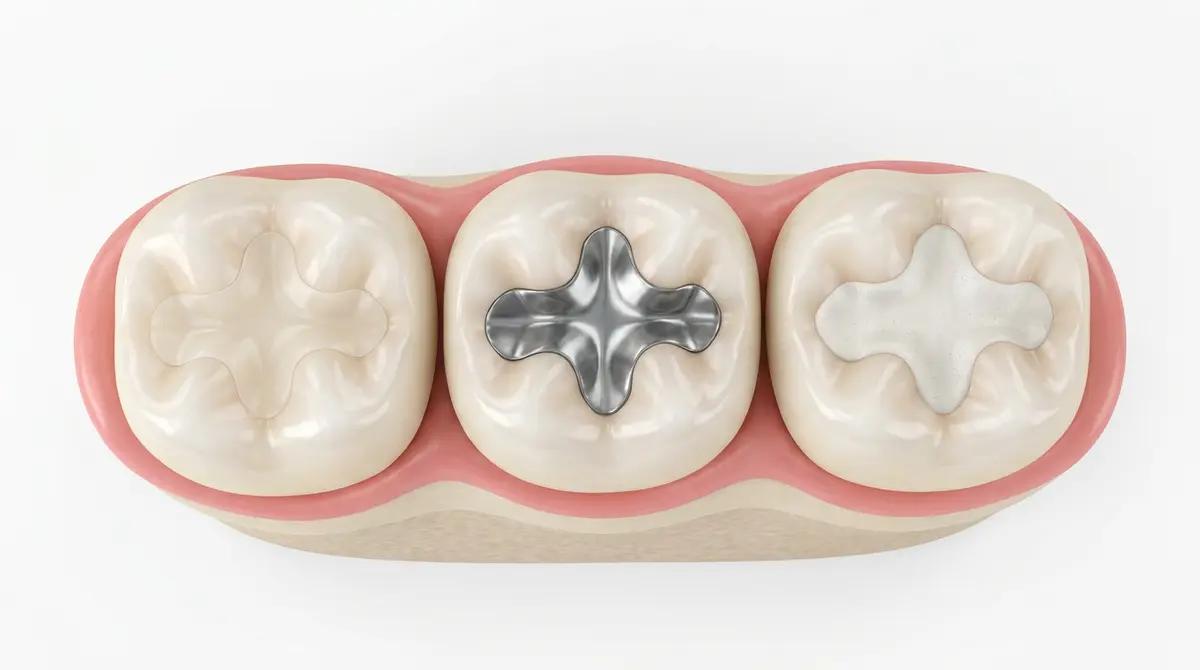
Dental amalgam fillings are made from an alloy of mercury with silver, tin and copper. These are metal dental fillings. In 2020 the US Food and Drug Administration (FDA) issued recommendations on amalgam. The agency recommended avoiding it where possible for pregnant and breastfeeding women, children under 6 and people with kidney or nervous system diseases. The FDA does not advise removing intact amalgam fillings without a medical reason. Removal releases more mercury vapour.
At consultations patients often ask us whether old grey amalgam dental fillings should be replaced with white ones. If the filling is intact and there is no caries under it, we do not advise replacing it just because of the mercury. We suggest replacement when there is a chip, a gap at the edge or secondary caries.
Which filling is best
On front teeth we usually choose composite, and we match its shade to the colour of the enamel. On chewing teeth, for ordinary cavities, we also use composite more often. If the tooth is badly destroyed, we may suggest a crown. For children and for a high risk of caries, glass ionomer cement may be appropriate.
What are the safest dental fillings? For the groups named in the FDA advice above, the safer choice is a filling without mercury: composite or glass ionomer cement. We will confirm the choice at the examination.
Has your filling darkened or chipped?
We will check it at an examination and on an X-ray and suggest a replacement if it is needed.
How long do dental fillings last
How long a filling lasts depends on its size, the material, hygiene and the chewing load. According to an international review, the lifespan of fillings in chewing teeth varies. The median here is the time that half of the fillings outlast. So what are the most durable filling materials? In this review amalgam lasted longer than composite.
Composite fillings were most often replaced because of secondary caries, and amalgam fillings because of fractures. Composites keep improving, and long-term data on how they hold up are still being collected. Hygiene strongly affects how long a filling lasts. So does bruxism, that is, grinding of the teeth.
Secondary caries under a filling

Secondary caries under a filling develops at its edge. Plaque collects there and bacteria get inside. From outside the filling may look intact.
How fast does caries develop under a filling
Usually slowly. But in dentine the process goes faster than in enamel. That is why, at check-ups and on X-rays, we look for darkening at the edge of the filling or a gap. More on the early signals in the article on cavity symptoms you should not ignore.
How do dental fillings work? How a filling is placed
Anaesthesia
We give a local anaesthetic if it is needed.
Isolation
We protect the tooth from saliva.
Caries removal
We remove the affected tissue.
Filling
We prepare the surface and apply the material in layers.
Shaping
We give the filling its shape, check the bite and polish it.
How long do dental fillings take? It depends on the size of the filling and on how many layers it needs, so we will tell you after the examination.
When to see a doctor
- the filled tooth hurts on its own or at night;
- pain when biting does not go away after more than a few days;
- the filling gets in the way when you close your teeth;
- a piece has chipped off or a gap has appeared;
- the edge of the filling has darkened.
Are dental fillings painful? We work under a local anaesthetic if it is needed. Do dental fillings hurt afterwards? Slight sensitivity to cold in the first days after treatment happens and passes by itself. The information in this article is for general guidance and does not replace a consultation with a dentist.
Filling prices at Cristi Dent
Prices are valid as of 19 October 2026. We choose the material and the amount of work after the examination. More on the caries treatment page.
Need to replace old fillings?
Book a free consultation: we will tell you which fillings should be replaced and which will still serve you.
Where to go for help
If a filling needs replacing or a new cavity needs treatment, start with an examination. We carry out caries treatment in Chișinău. We choose the material for the specific tooth.
Sources
- Longevity of Amalgam Versus Composite Resin Restorations in Permanent Posterior Teeth: A Systematic Review. Cureus. 2025;17(7):e88836 pubmed.ncbi.nlm.nih.gov/40873828
- FDA (24.09.2020). FDA issues recommendations for certain high-risk groups regarding mercury-containing dental amalgam www.fda.gov/news-events/press-announcements/fda-issues-recommendations-certain-high-risk-groups-regarding-mercury-containing-dental-amalgam
How to extend the life of a filling
- clean your teeth regularly and clean between them with floss;
- do not bite nuts, ice or hard objects;
- wear a night guard if you grind your teeth;
- come to check-ups on the schedule we set.
How often do dental fillings need to be replaced?
Only when there is a reason: secondary caries, a chip, a gap at the edge, pain. We do not advise removing an intact filling, based on our experience and the FDA recommendations.
Frequently asked questions
Usually for years, but the exact time depends on the size of the filling, the material, hygiene and the chewing load. Grinding the teeth and poor cleaning shorten it noticeably.
Most often the filling is slightly too high and gets in the way when the teeth close. Other causes are inflammation of the nerve or of the tissues at the root, or a crack. If the pain lasts more than a few days, you need an examination.
Light-cured composite hardens under the lamp at once. But if you had an anaesthetic, it is better to wait until the numbness passes so that you do not bite your cheek.
On front teeth we usually place composite, and we match its shade to the colour of the tooth. If the tooth is badly destroyed, we will suggest a crown.
A consultation with a specialist doctor at Cristi Dent is free. We will check your old fillings and tell you which ones should be replaced.
ARTICLE AUTHOR
Treats caries (tooth decay), restores teeth with fillings and works to preserve the patient's own teeth.