All on 6 and All on 5 Full-Jaw Dental Implants in Chișinău
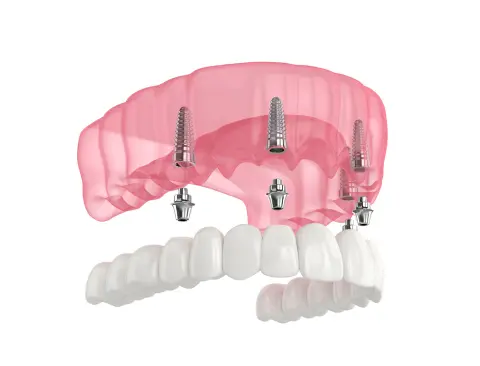
All on 6 and All on 5 dental implants are a full restoration of the dental arch on 5 or 6 implants, finished with a fixed prosthesis that you do not remove.
Additional supports spread the chewing load more evenly and make the structure more stable. We suggest these protocols to patients with a strong bite, heavy chewing load or enough bone for a larger number of implants.
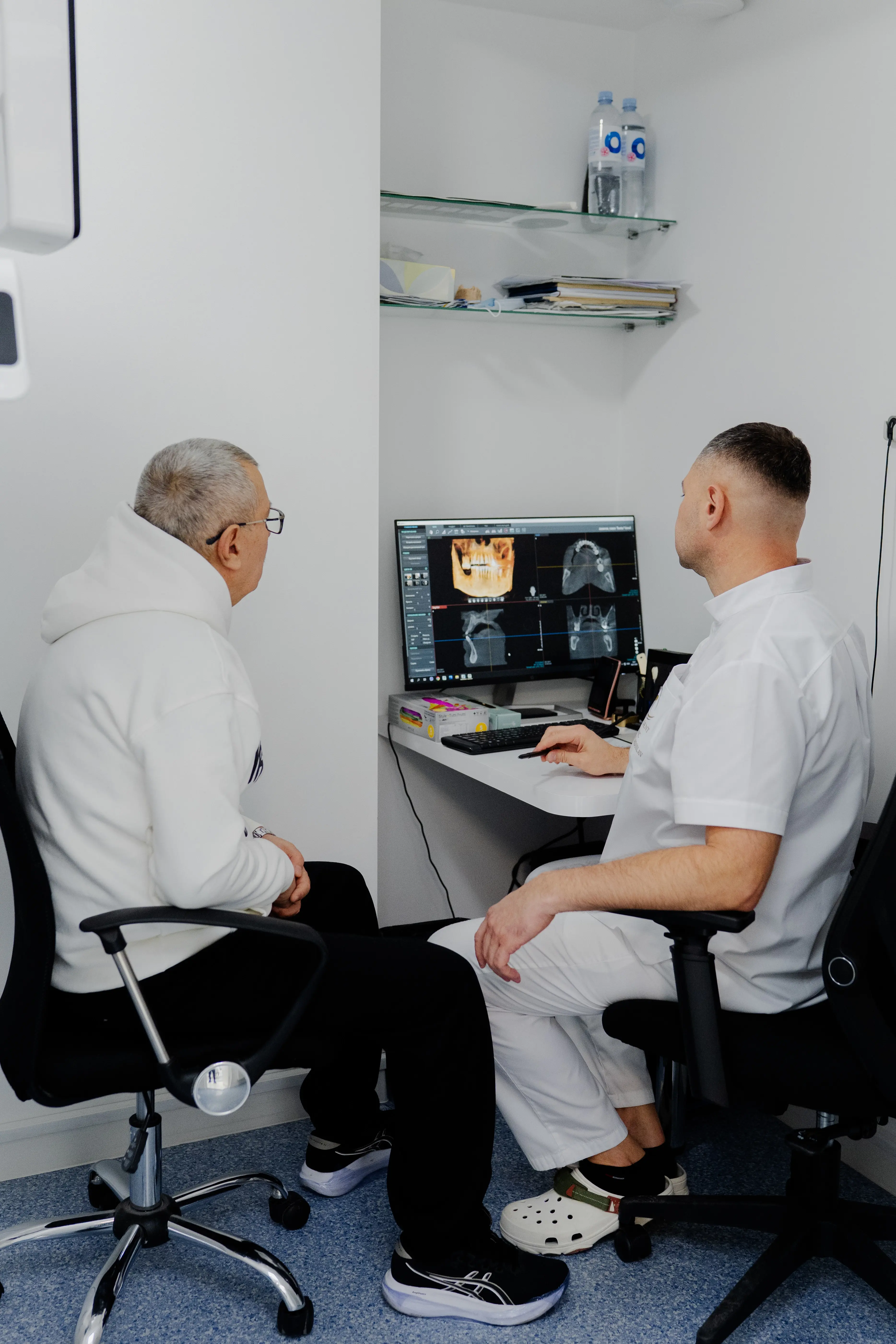
Before treatment we take a CBCT scan (3D dental scan) and assess the volume of bone, your bite and the expected load. After that the doctor explains whether All on 5 or All on 6 suits you and what the treatment will consist of.
When All-on-5 and All-on-6 are suitable
- All teeth are missing on one or both jaws
- The remaining teeth cannot be saved
- Removable dentures are uncomfortable or impossible to wear
- It is hard to chew solid food properly
- There is marked bone loss after a long period without teeth
- A fixed structure matters more to you than a removable denture
Comparison of full-jaw implant protocols
| Criterion | All-on-5 | All-on-6 |
|---|---|---|
| Number of implants | 5 | 6 |
| Stability of the structure | Higher thanks to an additional support | Maximum stability |
| Distribution of chewing load | More even distribution of the load | The most even distribution of the load |
| Bone volume required | A somewhat larger bone volume is required | Good bone volume is required |
| Risk of overloading the implants | Lower thanks to an additional support | Minimal |
| Who it suits | Patients with a heavy load or partial bone loss | Patients with a strong bite, bruxism (teeth grinding) or higher demands for durability |
| Cost | Affordable | Higher |
All-on-5 dental implants
All-on-5 means placing five implants to support a complete fixed prosthesis. The additional support can be used to spread the load, taking into account your individual anatomy and the prosthetic plan.
We do not choose the five-implant method automatically. It is chosen after diagnostics. The doctor assesses the bone, your bite and the position of the future implants, and explains whether five supports have an advantage in your situation.
All-on-6 dental implants
All-on-6 is the restoration of a full dental arch on six implants. The additional supports allow the doctor to distribute the load along the dental arch, taking into account the condition of the bone and the features of your bite.
The six-implant protocol is used for complete or almost complete tooth loss, when six implant supports are planned for the future fixed prosthesis.
All on 6 treatment ends with a temporary prosthesis and, after the implants have integrated, a permanent one. Whether and when the implants can take load is decided individually.
When All-on-5 or All-on-6 may not suit you
A full-jaw rehabilitation may not be recommended if:
- There are serious contraindications to implants:
uncontrolled diabetes, blood diseases, cancer, or medicines that impair healing. - The bone is severely shrunken (atrophied) and cannot be used to support implants,
even with angled implants (placed at an angle) or additional techniques. - The chewing load is very high or there is bruxism that cannot be controlled,
which raises the risk of overloading the structure. - You have teeth that can be restored.
In that case a full-jaw rehabilitation may be excessive.
Results of full-jaw dental implants
After treatment the teeth do not come out, do not shift and need no constant attention in daily life.
The structure is firmly fixed, so it does not move, rub or create awkward moments.
Over time you can eat your usual food instead of adapting your diet to weak or missing teeth.
This is not an interim prosthesis for now but a permanent solution designed to last for years, with check-ups and occasional adjustment.
All-on-5 prices
The system is designed to work with different bone densities and in more difficult fixation conditions.
It is the best option for a higher load on the back areas of the jaw.
The additional implant helps spread the load on the structure more evenly.
It suits a strong bite and active chewing of solid food.
Gives higher stability of the structure under a high chewing load.
It suits patients who need an extra reserve of strength for the long term.
All-on-6 prices
Used for a complex bone structure and high chewing loads.
It is chosen when more reliable fixation is needed in the back zones.
Six implants give a more even distribution of the load across the whole arch.
It suits a strong bite and the need for maximum stable fixation.
The most reinforced option for patients with a heavy bite load.
We recommend it for bruxism and constant strong pressure when chewing.
Stages of treatment under the All-on-5 and All-on-6 protocols
CBCT scan, assessment of bone volume, bite and load. The doctor explains which protocol suits you and why.
If needed, we remove problem teeth and clear sources of inflammation, so that the implants heal without complications.
The implants are placed in one visit following the surgical protocol. The same day we form the base for the future teeth.
We fix temporary teeth that you can talk and carefully eat with. You do not have to go without teeth while the implants heal.
After the implants have integrated, we make the permanent fixed prosthesis. This is the final version you live with every day.
How long a full-jaw rehabilitation takes
• Surgery and implant placement: 1 day
The main surgical stage takes place in one visit.
• Adaptation period with temporary teeth: 2-4 months
During this time you already have teeth, get used to the structure and gradually return to your usual food.
• Permanent teeth: after the implants stabilise
The final prosthesis is made once the implants have integrated and is fixed as the permanent solution.
The exact timing depends on the condition of the bone, your bite and the amount of treatment. The doctor names it after the CBCT scan and consultation.
All on 6 dental implants FAQ
Don't put off your dental health